Salmon is a favorite for home cook. It is rich in heart-healthy omega-3 fatty acids, cooks quickly, and offers a delicious, buttery flavor when prepared right. However, cooking salmon to perfection at home can be surprisingly tricky.
Because fish loses moisture rapidly when overcooked, the line between a tender, succulent fillet and a dry, chalky mess is remarkably thin. The good news? You do not need years of culinary training to get restaurant-quality salmon every single time. By understanding a few core principles and using a reliable instant-read food thermometer, you can master salmon cooking once and for all.
What Are the Common Struggles of Cooking Salmon
Understanding why fish turns out disappointing is the first step toward fixing it. Home cooks frequently encounter four major pain points when preparing salmon, all of which stem directly from uncertainty surrounding heat and timing.
The Dreaded Dry, Chalky Texture:
Overcooking is unequivocally the single most widespread mistake in seafood preparation. Because salmon is relatively low in tough collagen compared to red meat, its protein structures tighten rapidly under high heat. Once internal temperatures climb too high, natural moisture and aromatic oils are squeezed completely out of the flesh, leaving behind a chalky, fibrous bite that requires extra sauce just to swallow.
Uneven Thickness Across the Fillet:
A standard salmon fillet is naturally tapered—it features a thick, meaty center cut that thins out drastically toward the belly or tail end. When cooked over uniform heat, the thin tail section inevitably reaches well-done territory long before the thick center is cooked through, leaving cooks with a single piece of fish that is simultaneously overdone on one side and underdone on the other.
Visual Guesswork and Moisture Loss:
Lacking a definitive way to measure doneness, many recipes advise cooks to use the “poke test” or flake the fish open with a fork to peek inside. Unfortunately, flaking or cutting into the flesh while the fish is actively cooking ruptures the delicate muscle walls, allowing essential moisture to escape right onto the hot pan. Furthermore, visual color alone is highly deceptive, as different species of salmon (such as wild King versus farmed Atlantic) display vastly different internal opacities even at the exact same temperature.
Excessive White Ooze (Albumin):
A very common and unappetizing sight for home cooks is the thick white substance that frequently pushes out onto the surface of a salmon fillet during cooking. That substance is albumin, a naturally occurring, soluble protein inside the fish. When the fish is subjected to overly aggressive heat or overcooked, muscle fibers contract aggressively like a squeezed sponge, pushing liquid albumin to the exterior where it coagulates. While totally safe to consume, heavy white albumin is a clear visual signal that the fish has lost its internal tenderness.
What’s the Ideal Internal Temperatures for Salmon
The single most powerful habit shift you can make in the kitchen is cooking by internal temperature rather than relying strictly on recipe clock times. Oven calibration varies, cookware heat retention differs, and no two fillets carry identical weight or thickness. Thermometer readings remove every variable from the equation, giving you precise control over your results.
Navigating Temperature and Food Safety
Understanding temperature nuances helps you decide exactly how to pull your fish for maximum flavor:
Medium-Rare (120°F-125°F / 49°C-52°C): At this level, the salmon retains a translucent, highly silky core reminiscent of high-end bistro preparation. This temperature preserves the natural delicate sweetness of wild species like Sockeye or King salmon, which lean thinner and lower in fat than farmed varieties.
Medium (130°F-135°F / 54°C-57°C): Considered by culinary professionals to be the absolute optimal sweet spot for home cooks. The salmon flakes effortlessly under a fork while retaining a wonderfully moist center and rich mouthfeel.
Well-Done / USDA Standard (145°F / 63°C): The official guideline provided by the United States Department of Agriculture (USDA) recommends an internal temperature of 145°F for seafood to ensure safety against foodborne pathogens. While guaranteed safe, cooked salmon kept on direct heat all the way to 145°F often turns dry due to carryover cooking.
Crucial Technique – Carryover Cooking:
Protein does not stop cooking the moment it leaves a hot pan or oven. Residual heat stored on the outer surfaces of the fish continues traveling inward for several minutes after removal. To hit your desired final temperature without overshooting into dryness, always remove your salmon from the heat source when it reads 5°F below your final target, then allow it to rest undisturbed on a warm plate for 3 to 5 minutes before serving.
Which Instant-Read Food Thermometer is Good for Cooking Salmon
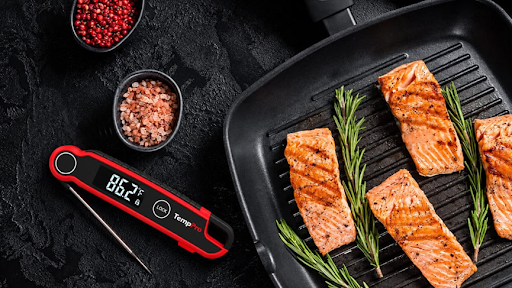
While cooking techniques matter, your gear determines your consistency. The TempPro TempSwift ELITE TP620 Instant-Read Meat Thermometer is specifically designed to eliminate these problems with precision engineering tailored for home cooks.
Key Advantages for Everyday Home Cooks
Ultra-Fast Speed Protects Cookware Heat: Seafood passes through ideal doneness windows in seconds. With the TempPro TempSwift ELITE TP620’s lightning-fast 0.5 second sensor response time, you get instant clarity without holding your oven door open or hovering your hand over an scorching hot skillet for too long.
High Precision: Featuring high-precision sensor technology with an accuracy of ±0.9°F (±0.5°C) across standard cooking ranges, this tool removes dangerous estimation errors. You can confidently pull salmon right at 125°F knowing your readings are true.
180° Auto-Rotating Backlit Screen: Outfitted with a motion-sensing auto-rotating backlit screen, the bright LCD stays perfectly readable whether you are cooking left-handed, probing from an awkward angle inside a hot oven, or grilling outdoors after sunset.
Hygienic and Easy to Clean: Cooking fish involves working with oils and delicate juices. Thanks to its certified IP65 waterproof rating, you can wash the entire unit safely under running tap water without worrying about water damage inside the casing.
Step-by-Step Guide to Cooking Salmon
Pan-searing is arguably the most popular way to prepare salmon because it creates a stunning contrast between golden, crackling skin and velvety tender flesh. Follow these detailed steps for foolproof execution:
Step 1: Thoroughly Dry the Exterior
Moisture is the direct enemy of crisping. Use heavy-duty paper towels to press dry all sides of your salmon fillets, paying special attention to the skin side. Damp skin will steam in the pan rather than sear, leading to rubbery skin.
Step 2: Season Right Before Cooking
Apply kosher salt and fresh black pepper evenly over both sides. Avoid salting fish too far in advance, as salt draws moisture out of the interior flesh over time.
Step 3: Preheat Your Cookware
Place a heavy cast-iron skillet or stainless steel pan over medium-high heat. Add a tablespoon of high-smoke-point oil, such as avocado, canola, or grapeseed oil. Wait until the oil shimmers and barely begins to wisp smoke before adding fish.
Step 4: Sear Skin-Side Down First
Carefully lay the fillet into the hot oil away from you to avoid splashing. Immediately press down firmly across the top of the fillet using a thin metal spatula for roughly 10 seconds; this counteracts the natural contraction of the skin and ensures flat, uniform contact with the pan. Cook skin-side down undisturbed for about 70% of the total cooking duration, approx. 4 to 5 minutes.
Step 5: Flip and Monitor with Precision
Turn the fillet over gently. Slide your instant-read food thermometer horizontally into the thickest center region of the fish. As soon as the reading hits 125°F (for a target medium finish of 130°F), remove the pan entirely from the burner. Transfer the salmon to a serving platter and let it rest for 3 minutes so internal juices redistribute evenly.
FAQs about Cooking Salmon Using an Instant-read Meat Thermometer
Where exactly should I insert the thermometer probe in a salmon fillet?
Always target the center of the thickest part of the fillet, as this region takes the longest to cook. For thin or medium-thickness salmon, insert the probe horizontally from the side of the fillet toward the center rather than poking straight down from the top. Inserting horizontally ensures the sensor tip stays fully embedded within the thermal core of the flesh, giving you a true reading.
How can I minimize or stop the white liquid (albumin) from appearing on my salmon?
To prevent heavy albumin buildup, avoid blasting cold salmon with extreme heat. Bring your raw fillets out of the refrigerator 10 to 15 minutes prior to cooking so they drop their extreme chill, and cook over moderate, controlled heat. Most importantly, monitor the internal temperature with your TempPro TempSwift ELITE TP620 and pull the salmon off the heat before internal temps exceed 135°F, preventing the muscle fibers from over-contracting.
Is it safe to consume salmon cooked to 130°F instead of the official 145°F recommendation?
The USDA official guideline of 145°F is structured to guarantee pathologically safe food for all populations. However, standard professional culinary practice routinely serves high-quality farm-raised or wild salmon at 125°F-135°F for superior texture and flavor. If you choose to cook your salmon below 145°F, always purchase fresh, high-grade salmon from trustworthy seafood markets or fishmongers with proper cold-chain storage.
Q4: Is it better to cook salmon with the skin left on or removed?
Cooking with the skin on is strongly recommended even if you choose not to eat the skin afterward. The tough skin layer acts as a natural heat buffer between the scorching pan surface and the sensitive meat, shielding the interior from heat shock, locking in natural fats, and preventing the fillet from breaking apart when flipped.