CNLawBlog Explained: What Readers Should Know Before Using It
A clear look at CNLawBlog.com, its history, topics, editorial rules, legal content, guest posting policy, and important facts readers should check.

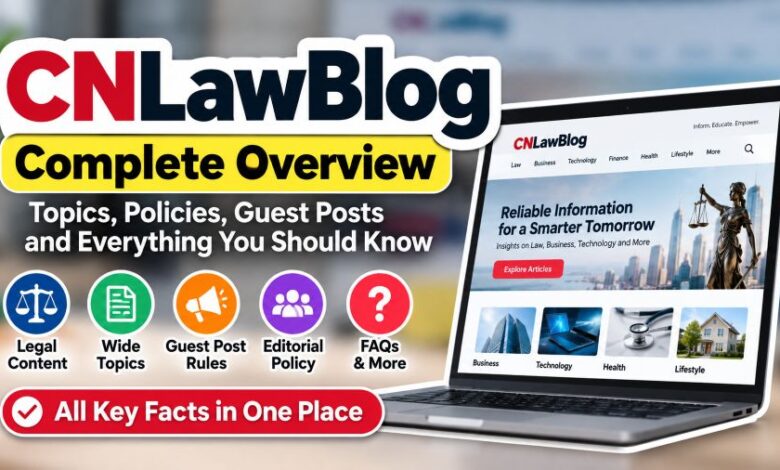
CNLawBlog has an interesting name.
At first, it sounds legal-only. Actually, the site covers much more.
CNLawBlog.com describes itself as an independent digital publication. It says the publication began in August 2018 with a strong base in legal publishing. Since then, its subject range has grown.
Law remains a main section.
But readers can also find technology, finance, business, education, health, lifestyle, real estate, gaming, home improvement, and consumer-focused articles.
So, what exactly is CNLawBlog?
Here is the clear answer.
CNLawBlog is an informational publishing website that covers legal topics alongside business, finance, technology, health, education, lifestyle, and other general-interest subjects.
It is not a law firm.
Its legal content is informational. Readers needing advice about their own case should check qualified professional sources.
Quick Facts About CNLawBlog
| Fact | Details |
|---|---|
| Website | CNLawBlog.com |
| Publication type | Independent digital publication |
| Stated founding date | August 2018 |
| Original base | Legal publishing |
| Current focus | Multi-topic informational content |
| Main subjects | Law, technology, business, finance, education, health and more |
| Legal advice | No, informational content |
| Guest posts | Accepted |
| Guest post links | 1–2 relevant dofollow links allowed |
| Minimum guest post length | 500 words |
| Preferred guest post length | 1,000+ words |
| Human editorial review | Site says yes |
| Content updates | Site says older articles may be updated |
| Official individual founder | Not clearly named on pages checked |
| Public owner details | Not clearly stated on pages checked |
CNLawBlog’s own About page supports its August 2018 start and its wider subject coverage. Its guest-post and editorial pages explain submission rules, human review, and update practices.
What Is CNLawBlog?
Basically, CNLawBlog is a publishing website.
The site’s stated aim is simple. It wants complex information written clearly.
That goal appears across many subjects.
Its About page names law, technology, business, finance, education, health, home improvement, real estate, lifestyle, gaming, consumer information, and practical guides among its coverage areas.
This matters.
A reader searching the name may expect only legal articles. The current site is much broader.
Its navigation also shows sections for technology, finance, business, education, health, lifestyle, real estate, law, travel, automotive, fashion, politics, and sports.
The legal area has its own subcategories.
These include Accident Law, Civil Law, CNLaw, Corporate Law, Criminal Law, Family Law, and Personal Injury Law.
How Did CNLawBlog Start?
CNLawBlog says it was founded in August 2018.
The publication describes its early base as legal publishing. Later, coverage spread into other subject areas.
Older posts support that timeline.
For example, the site currently carries archived content dated August 2018, while its homepage also surfaces older legal material from the same period.
Still, one distinction matters.
The site tells readers when it says the publication began. That does not give us a verified individual founder.
The official pages checked for this article do not clearly name a person as the founder or owner.
So those names should not be guessed.
What Topics Does CNLawBlog Cover?
Law gets strong visibility.
Yet it is one part of a bigger site.
Current editorial information names these broad areas:
- Law and legal information
- Technology
- Business
- Finance
- Education
- Health
- Home improvement
- Real estate
- Lifestyle
- Gaming
- Consumer information
- General informational subjects
The live navigation also contains travel, automotive, fashion, politics, and sports sections.
This makes the site closer to a general digital publication than a narrow specialist legal database.
That difference is useful.
Someone researching a legal issue should check the category, author, date, jurisdiction, and original source behind a claim.
What Legal Content Appears There?
CNLawBlog keeps a sizeable legal section.
The site’s current structure separates several types of law content. Corporate Law and Criminal Law appear beside Civil Law, Family Law, Personal Injury Law, and Accident Law.
Recent homepage material has included articles involving insurance claims, personal injury, birth injuries, and legal services.
But there is an important limit.
CNLawBlog itself says its material is informational rather than professional legal advice. Its own CNLawBlog explainer makes that distinction clear.
That means readers should use the site for general reading.
A personal legal problem is different.
Laws can change by country, state, province, court, date, and case facts. So readers should check current primary sources or speak with an appropriately qualified professional before acting on high-stakes legal information.
Is CNLawBlog Only About China?
No current official description I checked says CNLawBlog.com is exclusively a China-law publication.
That is an easy mistake.
The name looks similar to China Law Blog.
They should not be mixed together.
China Law Blog is published by Harris Sliwoski. Its archive goes back to January 4, 2006, and the publication says its original purpose was to discuss practical Chinese law issues affecting businesses operating in or dealing with China.
CNLawBlog.com says it began in August 2018 and now covers many subject areas.
These are different publications.
Also, I found no clear statement on CNLawBlog’s current About page explaining exactly what the letters “CN” mean.
It is better not to invent that answer.
Who Writes for CNLawBlog?
Current site pages show author names including Jamie and mansi.
Jamie appears across several subject areas, while mansi appears on some 2026 finance-related posts shown on the homepage.
Here is the catch.
A displayed author name is not the same thing as verified professional credentials.
The public material checked for this article did not provide enough evidence to assign legal, medical, or financial qualifications to those authors.
Readers should keep that distinction clear.
For casual information, an article may answer the question.
For money, health, legal rights, or regulatory matters, source quality matters much more.
How Does Its Editorial Process Work?
CNLawBlog publishes an Editorial Policy.
That gives readers useful context.
The policy says topics can be selected using reader interest, search intent, relevance, informational value, and long-term usefulness.
Research may use public sources such as government websites, official organizations, academic publications, industry documents, technical references, manufacturer information, and public reports.
Before publication, the site says articles are checked for factual consistency, grammar, readability, organization, formatting, internal links, and general quality.
The policy also discusses corrections.
Older content may be changed when facts become outdated, laws change, new information appears, references need updating, or an error needs fixing.
That is useful for readers.
Dates still matter, though.
Always check them.
Does CNLawBlog Use AI or Digital Writing Tools?
The editorial policy addresses this directly.
CNLawBlog says digital tools may assist with research organization, drafting, language work, grammar checking, and content work.
The same policy says technology does not replace editorial judgment.
It also says each published article is subject to human review before publication for clarity, structure, factual consistency, and quality.
That is the site’s stated process.
Readers should judge each article separately.
Check sources. Check dates. Check claims.
Simple habit. Big difference.
Does CNLawBlog Accept Guest Posts?
Yes.
CNLawBlog has a public guest-post page.
It invites writers, bloggers, professionals, and industry contributors to submit articles across legal subjects, business, finance, entrepreneurship, technology, gaming, education, careers, self-development, and general informational topics.
The stated minimum length is 500 words.
The site says 1,000+ words is preferred.
Content must be original.
The guidelines also tell contributors to avoid misleading, excessively promotional, low-value, or copied material. Facts and data should be presented accurately.
What Is the CNLawBlog Backlink Policy?
This part is clearly published.
CNLawBlog says guest posts may contain 1–2 dofollow backlinks.
Links must be relevant.
Spammy or harmful links are prohibited. Affiliate links in guest submissions are also rejected under the stated policy.
The site says guest submissions are manually reviewed.
Its guest-post page gives a normal response window of 24–72 hours.
Is guest posting always free?
The site’s own FAQ says it depends on the content type and submission requirements. Contributors are told to contact the site for details.
So a fixed public price should not be invented.
Is CNLawBlog a Law Firm?
No evidence from the official pages checked shows CNLawBlog.com operating as a law firm.
It identifies itself as an independent online publication.
That wording matters.
Legal articles can explain topics.
They cannot automatically replace a lawyer.
The website itself says its legal information is not professional legal advice.
Readers dealing with court deadlines, contracts, injury claims, criminal matters, family disputes, immigration issues, taxes, or business compliance should verify the current law that applies to their exact situation.
Can You Trust Information on CNLawBlog?
There is no single yes-or-no test.
Look at the evidence instead.
CNLawBlog publishes an About page and an Editorial Policy. It explains its research process, correction practices, technology use, guest-post rules, and human review process.
Those are useful transparency signals.
Still, the site covers several high-stakes subjects.
Legal information changes.
Financial conditions change too.
Health guidance can depend on the person.
So readers should check whether an article gives solid sources, whether its publication date remains current, and whether the information matches official guidance.
Honestly, that rule applies anywhere.
Do not trust a page blindly.
Check the claim itself.
Who Is CNLawBlog For?
The site says its audience includes students, professionals, business owners, homeowners, researchers, consumers, and other readers looking for understandable information.
That matches its broad topic range.
A student might read a legal explainer.
A business owner may read finance content.
A homeowner may land there through real estate.
Someone else may arrive from technology.
Basically, search intent can vary a lot.
Important Details That Remain Unconfirmed
Some information is easy to find.
Some is not.
The official material checked does not clearly identify an individual founder or current individual owner.
I also found no reliable first-party figure for monthly visitors, revenue, company size, staff count, or an official physical headquarters.
Exact SEO metrics can change too.
DA, DR, traffic estimates, and keyword numbers from third-party tools should never be written as permanent site facts.
Check them live before publishing them.
The same rule applies to guest-post prices.
CNLawBlog does not publish one fixed price on the guest-post page checked for this article.
Why People May Search for CNLawBlog
Several search intentions make sense.
Some people want legal information.
Others want to know what the website actually is.
SEO users may be checking guest-post access or backlinks.
Readers may also be trying to separate CNLawBlog.com from China Law Blog.
That last point matters.
The similar names can cause confusion.
CNLawBlog.com states that it began in 2018 as an independent publication with a legal base and now covers many subjects. China Law Blog belongs to Harris Sliwoski and has an archive going back to January 2006.
Final Thought
CNLawBlog started with law in focus.
Today, its scope is wider.
The website covers legal topics alongside business, finance, technology, education, health, real estate, lifestyle, gaming, and other subjects. Its official pages also publish editorial rules, correction practices, guest-post requirements, and a stated human-review process.
Still, readers should know the limit.
CNLawBlog is an informational publication.
It is not a substitute for personal legal advice.
And some company-level details remain unclear.
So use what can be checked.
Skip what cannot.
That keeps the picture accurate.
FAQs About CNLawBlog
What is CNLawBlog?
CNLawBlog.com is an independent online publication covering law, technology, business, finance, education, health, real estate, lifestyle, gaming, and other informational subjects.
When was CNLawBlog founded?
Its official About page says CNLawBlog was founded in August 2018.
Is CNLawBlog a law firm?
The site presents itself as an independent digital publication, not a law firm. Its legal material is informational.
Does CNLawBlog only publish legal articles?
No. It currently covers law plus technology, finance, business, education, health, lifestyle, real estate, gaming, home improvement, and other subjects.
Is CNLawBlog the same as China Law Blog?
No. China Law Blog is published by Harris Sliwoski and dates back to January 2006. CNLawBlog.com says it began in August 2018.
Does CNLawBlog accept guest posts?
Yes. Its contribution page accepts original articles that match its subject areas and publishing standards.
Does CNLawBlog allow dofollow backlinks?
Its current guest-post policy says 1–2 dofollow backlinks are allowed when relevant. Spammy, harmful, or unrelated links are not accepted.
Does CNLawBlog use AI tools?
Its editorial policy says digital tools may assist parts of the content process. The same policy says published articles receive human review before publication.