Maintaining a car’s paintwork in good condition isn’t always easy. Everyday driving exposes the exterior to stone chips, road grime, bird droppings, harsh sunlight and minor scratches. No matter how often you wash, you cannot prevent all kinds of damage. Many car owners therefore opt for advanced paint protection solutions, such as borophene coating and traditional paint protection film (PPF).
Both of these are intended to help keep the look of the vehicle, but they do it in different ways and are for different needs. Knowing what they do well, what their limitations are and how much work they need to keep running can help you pick a solution that makes sense for your car and your budget.
What is a Borophene film?
Borophene is a two-dimensional material made up of boron atoms. Its unusual physical and electronic properties have attracted scientific interest. But in automotive detailing, “borophene coating” can refer to a marketed coating formulation, instead of a pure, standalone layer of borophene.
This distinction is important because the performance of a coating depends on its actual ingredients, formulation, application process, and supporting test data. Buyers should consult the technical data from manufacturers rather than assume that all products sold under this name will deliver the same benefits.
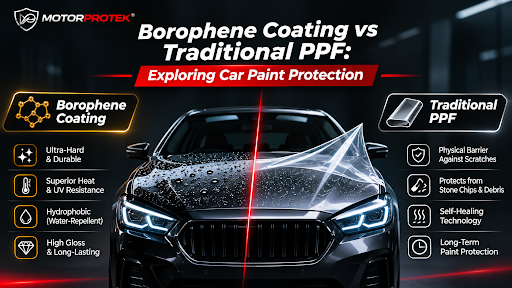
Depending on the formulation, a surface coating may help in improving water repellency, facilitate routine cleaning and improve the appearance of automotive paint. It can also offer some resistance to certain contaminants. However, it should not be considered automatically as a substitute for a physical protective film.
Paint Protection Film: The Basics
Traditional paint protection film is a physical film applied over the painted surfaces of a vehicle. Many modern products use thermoplastic polyurethane (TPU) . It is a flexible material meant to absorb some small impacts and resist abrasion.
Instead of a surface coating, PPF acts as a barrier between the paint and hazards like loose stones, road debris and light scratches. A few premium film products also have self-healing topcoats that can help to make minor surface marks less visible under suitable heat conditions.
Vulnerable areas such as the bonnet, front bumper, side mirrors and front fenders can have PPF applied. Owners wanting broader coverage may opt for a full-body installation. The end result is dependent on film quality, condition of the vehicle and standards of installation.
Borophene Coating vs PPF: Major Differences
1. Physical security
The biggest difference is how each choice protects the surface. A coating is a thin layer on the surface of the paint, mainly used to improve surface performance and maintenance. It isn’t generally engineered to take hits from stones.
PPF however serves as a physical barrier which can help to mitigate the risk of chips and minor abrasion. This can be especially important for drivers who spend a lot of time driving on highways or roads with loose gravel.
Neither solution makes a vehicle completely damage proof and deep impacts can still cause damage.
2. Appearance and Luster
Coatings are often selected by owners because of their polished appearance, improved water behavior and ease of cleaning. Depending on the formulation, they can give the paint visual depth.
PPF comes in various finishes such as gloss and matte. Gloss film can preserve or increase glossiness, while matte options create a low reflection, satin appearance. This gives PPF an edge for drivers who want to protect their paint, while changing or maintaining a particular finish.
3. Maintenace Requirements
Both solutions need good maintenance. Vehicles with a coating still require regular washing and contaminants should be removed promptly. Having a coating doesn’t mean you don’t have to take care of the paint.
PPF should also be washed with appropriate automotive products. Harsh chemicals, abrasive tools and careless pressure washing near film edges can damage film. Either choice is preserved by following the manufacturer’s maintenance instructions.
4. Cost & Long-Term Value
The overall cost depends upon the product, area to be covered, size of the vehicle, works to be done and installation charges. It’s worth mentioning that coatings and PPF have different application processes and service-life expectations so comparing prices only can be misleading.
Consider the type of damage you want to protect against, how long you expect to own the vehicle and the cost of any future repairs. A coating is sufficient support for routine cleaning and appearance for some owners. Others feel that the extra physical protection PPF gives is a more pertinent issue.
Can I use both at the same time?
Yes, in some instances. Vulnerable panels on a vehicle can receive PPF with a compatible coating applied over the film or other suitable painted areas. It can be combined with impact protection, easier cleaning and water repellency.
But compatibility is crucial. Always make sure the coating is approved for use over the particular film and follow the recommendations of both manufacturers.
Conclusion
In car care, borophene coating and traditional PPF are employed for different applications. A good coating can help to preserve the surface and paint protection film provides a physical barrier against some types of everyday damage.
If it’s the right choice for you depends on your expectations, driving conditions and budget. Based on the product evidence, installation quality and warranty terms, you can choose a protection strategy to keep your car looking its best over time.