AnscaMobile.com: The Company Behind Corona SDK and What Happened to It
The story of an early mobile development company, its popular game-building software, the people behind it, and the project that survived its closure.

Introduction
AnscaMobile.com was once connected to a well-known mobile software company. Its name was Ansca Mobile. The company created Corona SDK, a tool that helped developers build mobile apps and 2D games without writing separate code for every device.
The idea was simple. Write code once. Build for different platforms.
That mattered a lot in the early smartphone years. Developers wanted to reach iPhone and Android users, but maintaining separate projects was difficult and expensive.
Ansca Mobile offered another way.
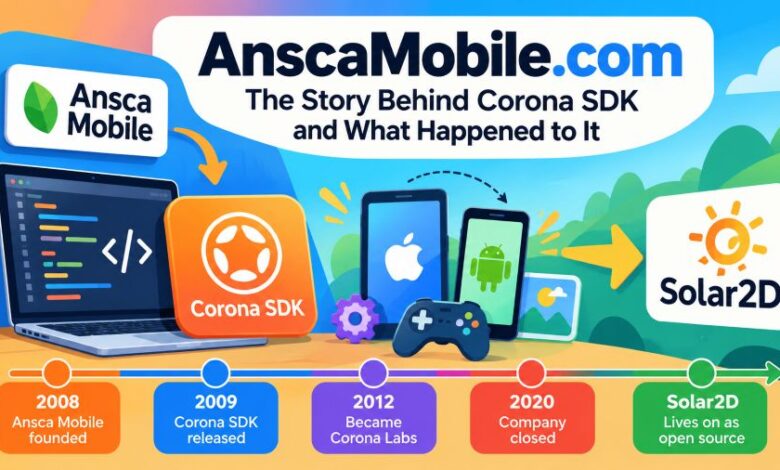
The company later changed its name to Corona Labs. Its business closed in 2020, but its main software survived. Today, that technology continues through the open-source project Solar2D.
Quick Facts
| Detail | Information |
|---|---|
| Website | AnscaMobile.com |
| Original company | Ansca Mobile |
| Later name | Corona Labs |
| Founded | 2008 |
| Founders | Carlos Icaza and Walter Luh |
| Original headquarters | Palo Alto, California, USA |
| Industry | Mobile software development |
| Main product | Corona SDK |
| Programming language | Lua |
| Main purpose | Building mobile apps and 2D games |
| Rebranding year | 2012 |
| Company closure | May 1, 2020 |
| Software successor | Solar2D |
| Original business status | Closed |
| Current domain status | Not independently verified |
The Beginning of a Small Software Company
Ansca Mobile started in 2008.
Its founders, Carlos Icaza and Walter Luh, had previously worked at Adobe. Both understood mobile software development and the problems programmers faced while creating applications for different devices.
At that time, smartphone applications were gaining attention. Apple’s App Store had opened, and Android was becoming another major platform.
But creating apps was not easy.
A developer building an iPhone app often needed different programming tools from someone developing for Android. Supporting both meant extra work.
Icaza and Luh saw an opportunity.
They wanted developers to spend less time rewriting code and more time building working applications.
The company established its operations in Palo Alto, California. Its early focus was mobile development software, especially tools that could make application creation easier for individuals and smaller teams.
In 2009, the business received $1 million in financing from Merus Capital. That investment supported its early growth and product development.
How the Main Development Tool Worked
Corona SDK became Ansca Mobile’s best-known product.
SDK stands for Software Development Kit. Basically, it means a collection of tools programmers can use to create applications.
Corona SDK used Lua, a lightweight programming language.
Developers could write instructions in Lua and use Corona’s built-in functions to handle graphics, movement, sound, touch controls, and other application features.
They did not need to write every function from scratch.
That saved time.
For example, imagine someone building a simple mobile puzzle game. The player moves objects, collects points, and completes levels.
The developer needs several things working together. Objects must move. Touch controls must respond. Graphics must appear correctly.
Corona SDK provided tools for handling many of these tasks.
It also included a simulator. Developers could test changes on a computer before preparing a mobile build.
The software was especially suited to 2D games, although it supported other kinds of applications too.
Why developers liked the cross-platform approach
Building for different mobile systems created real problems.
Screen sizes varied. Device features differed. Programming requirements were not always the same.
Corona SDK offered developers a shared codebase.
That meant much of the application code could be used across supported platforms.
It did not remove every platform-specific requirement. Developers still needed to test their apps and meet the rules of each application store.
Still, the amount of repeated work could be reduced.
For small studios, that was attractive. One programmer could work on a project intended for more than one mobile platform.
The Software Products and Services
The business offered several development tools and related services during its operating years.
Standard software toolkit
The standard Corona SDK provided the main development environment.
It supported graphics, audio, animations, user input, and application logic.
Developers could create projects, test code, and prepare applications for supported mobile operating systems.
The tools helped reduce the amount of native code needed for many common functions.
Game development edition
In September 2010, Ansca Mobile announced Corona Game Edition.
This product focused more closely on mobile games.
It added a physics engine and sprite-sheet support. Game developers could use these features to handle object movement, collisions, and animated graphics.
The edition also supported OpenFeint integration, a gaming service used at that time for social features.
These features were useful for puzzle games and other 2D titles.
Enterprise development tools
Corona Enterprise arrived later.
It gave professional developers more flexibility when working with native device features and code.
This mattered for applications that required functions beyond the standard toolkit.
The product was aimed at teams with more technical requirements.
Simulator and testing tools
Testing was another useful feature.
Developers could run their projects in a desktop simulator, make changes, and see how those changes affected the application.
That shortened the time between writing code and checking the result.
Real-device testing was still necessary, especially for hardware-specific features and application-store requirements.
Learning and developer support
The company’s software attracted an audience of independent developers.
Its online resources included documentation, tutorials, developer discussions, and product announcements.
These materials explained how to create projects, work with Lua, manage graphics, and prepare applications for publishing.
For beginners, the available learning material could make getting started easier.
The Early Growth of the Platform
Corona SDK was first released in 2009.
At first, it focused on Apple’s mobile devices. Support for Android followed as the company developed its cross-platform system.
An important announcement came in April 2010, when Ansca Mobile introduced the public beta of Corona 2.0.
The update brought support for working across iPhone, iPad, and Android from a shared development environment.
By September 2010, the company had officially launched updated Corona SDK and Corona Game Edition products.
This was a meaningful period for mobile developers.
Independent teams were looking for affordable ways to publish games, while smartphone application stores gave smaller publishers a chance to reach large audiences.
Corona fitted that situation.
It offered a practical choice for developers who preferred Lua and wanted to build 2D applications.
A Famous Mobile Game Brought Attention
One of the best-known games associated with Corona SDK was Bubble Ball.
The physics-based puzzle game was created by Robert Nay, a teenage developer.
In January 2011, Bubble Ball reached the number-one position among free applications in the US Apple App Store.
That was a big achievement.
The game’s success attracted media coverage. It also drew attention to the software used to create it.
Bubble Ball involved moving objects and using physical interactions to guide a ball through puzzle levels.
Its development demonstrated that an independent creator could build a successful mobile game with Corona’s tools.
Ansca Mobile featured the game in its developer blog.
Other games associated with Corona included Blast Monkeys and The Secret of Grisly Manor.
These projects helped show the range of experiences developers could create with the framework.
How the Company Earned Money
Ansca Mobile originally used a commercial licensing model.
Developers could access development tools, while publishing applications through certain versions required a paid subscription.
Prices changed over time.
In September 2010, Corona SDK was offered for $249 per year. Corona Game Edition had an introductory annual price of $349.
These are historical prices.
They are not current software charges.
In 2011, industry reporting described a $199 annual licence for publishing to one platform and a $349 annual licence for cross-platform publishing.
The company also looked at ways to help developers promote their games.
One such service was LaunchPad.
It was intended to give developers better exposure and marketing support after publishing their applications.
Ansca Mobile also worked with Adknowledge on services connected to application distribution and monetisation.
The company’s business went beyond selling development software. It was trying to support the people who built and published mobile apps.
Why the Business Changed Its Name
In April 2012, Ansca Mobile changed its company name to Corona Labs.
The change connected the business identity more closely with its best-known software product.
Corona SDK had become the name developers recognised.
Using Corona Labs made the company’s identity easier to associate with its main technology.
The rebranding did not mean the original toolkit disappeared.
Development continued under the new business name.
Walter Luh served as chief executive after Carlos Icaza left that role.
In November 2012, Corona Labs announced an additional $2 million financing round involving Merus Capital and Western Technology Investment.
The investment was intended to support further development and business growth.
Changes in Ownership and Licensing
The following years brought several changes.
Corona Labs expanded its development tools, adjusted pricing, and experienced changes in ownership.
By June 2015, Corona SDK had become free to use.
This was a major difference from the earlier subscription model.
In March 2017, Appodeal acquired Corona Labs. The software continued to be offered without its former engine subscription charges.
The company also worked on supporting more platforms and giving developers access to native features.
Then came another change.
In 2019, Corona SDK became open source.
This meant its source code could be accessed under an open-source licensing arrangement.
Developers were no longer entirely dependent on a traditional commercial software subscription for the engine.
The move helped prepare the technology for a future outside the original company.
Why Corona Labs Closed in 2020
The closure was officially announced on February 12, 2020.
Corona Labs explained that the business was not bringing in enough income to cover its operating expenses.
That was the main reason given.
The company announced that its business operations would end on May 1, 2020.
But there was an important difference between closing a company and ending its software.
Corona Labs planned to let the development framework continue as an open-source project.
The company discussed this directly in its official February 2020 announcement.
The goal was to keep the engine available for existing developers and future projects.
Its community could continue working on the software even after the corporate business stopped operating.
The New Name That Followed
The software did not disappear.
In April 2020, the Corona team announced that the engine would take the name Solar2D.
The new name marked its separation from the closing corporate business.
Solar2D continued the Lua-based development approach that Corona SDK users already knew.
It also kept the focus on 2D applications and games.
Its code became available under the MIT License, a widely used open-source software licence.
The April 2020 transition announcement explained the new name and the work being done to support independent builds.
For developers using Corona, this offered a way to continue their projects without relying on the old company.
What Solar2D Offers Today
Solar2D is the direct continuation of the original development technology.
It remains a free, open-source framework for building 2D games and applications.
The project uses Lua and supports several publishing targets, including iOS, Android, desktop platforms, and HTML5.
Its main features include:
- Lua-based application programming.
- A desktop simulator for testing changes.
- Tools for graphics, animation, and physics.
- Audio and touch-input support.
- Plugins for extra application features.
- Support for publishing to different platforms.
- Access to the engine’s source code.
Developers can find downloads and documentation on the official Solar2D website.
The project also maintains a public GitHub repository, where developers can review its code and development activity.
Solar2D is free to use, with no engine licence fees or royalties. Other costs can still apply, such as application-store accounts or third-party services.
Is the Original Website Still Working?
There is an important distinction here.
AnscaMobile.com was the official website associated with Ansca Mobile. The domain appeared in company announcements during its operating years.
But the original business no longer operates.
During research in October 2026, the domain’s live website content could not be independently verified.
That does not prove the domain has expired. It also does not establish who currently owns it.
Its present registration details, site operator, and any current services remain unconfirmed.
Readers searching for the original development software should use Solar2D’s official website rather than assume an old Ansca download page is still supported.
Old installers can have compatibility problems. Unofficial mirrors may also contain outdated files.
Checking the source before downloading is a sensible choice.
What Made the Software Different?
The biggest attraction was its development approach.
Many programmers wanted to release applications for several devices without keeping completely separate projects.
Corona SDK gave them a shared codebase and a language that was relatively approachable.
Lua also had a smaller learning burden than some native development environments.
That did not mean every project was simple.
Developers still needed programming knowledge. Larger applications could require extra work, device testing, and native integrations.
Yet the framework gave smaller teams a useful starting point.
Its real strength was practical. Developers could build and test ideas quickly while keeping much of their code in one place.
Was the Company Legitimate?
Yes. Ansca Mobile was a documented American software business.
Its founders, products, investment announcements, and development history are supported by contemporary reporting and official company statements.
Corona SDK was used by real developers and appeared in published mobile games.
Its later corporate identity, Corona Labs, also maintained public announcements about software releases and business changes.
Still, the historical legitimacy of the company should not be confused with verification of the domain today.
A website can change ownership after its original operator closes.
For that reason, the company’s documented history does not establish the trustworthiness of any current content at the original web address.
Why Its History Still Matters
Ansca Mobile belonged to an early generation of companies trying to make mobile app creation more accessible.
Its founders understood a common problem. Supporting several mobile platforms required time, money, and technical work.
Corona SDK offered another development option.
Independent programmers could create projects using Lua, work with built-in game features, and publish to supported devices.
Some projects became widely known.
Then the company faced financial problems.
Its closure could have ended the product’s development. Instead, the source code remained available, and the developer community helped carry the engine into its next chapter.
That history is what connects Ansca Mobile, Corona Labs, and Solar2D.
Final Thought
AnscaMobile.com represents an important part of early mobile software development.
The website belonged to the company behind Corona SDK, a framework used for creating 2D games and mobile applications.
The business changed its name, went through ownership changes, and closed in May 2020.
But the software survived.
Solar2D continues that work as an open-source project.
For people researching the old domain, the answer is straightforward: Ansca Mobile is no longer operating, but its best-known technology still exists.
Frequently Asked Questions
1. What was AnscaMobile.com used for?
It was the official website associated with Ansca Mobile, a company that created software tools for building mobile applications and 2D games.
2. Who founded Ansca Mobile?
Carlos Icaza and Walter Luh founded the company in 2008. Both had previously worked on mobile software technologies at Adobe.
3. What was Corona SDK?
Corona SDK was a Lua-based development framework. It allowed programmers to create mobile apps and games using a shared codebase for supported devices.
4. When did the company change its name?
Ansca Mobile changed its name to Corona Labs in April 2012.
5. Why did Corona Labs close?
The company stated that its operating expenses exceeded the income generated by the business. It announced the closure in February 2020.
6. Is Corona SDK still available?
Its technology continues through Solar2D, a free, open-source development framework.
7. Is AnscaMobile.com safe to visit?
Its present website content and operator could not be independently verified during this research. The historical company was legitimate, but that does not establish the safety of the current domain.
8. Can beginners learn Solar2D?
Yes. Solar2D provides learning resources and uses Lua, which many beginners find approachable. Basic programming knowledge is still helpful.