Best Piononos de Santa Fe Near Me in the USA: What You Should Know
Searching for the famous Spanish pionono in America can get confusing fast. Here is what the real Santa Fe pastry looks like, where it comes from, and how to find the closest genuine match.

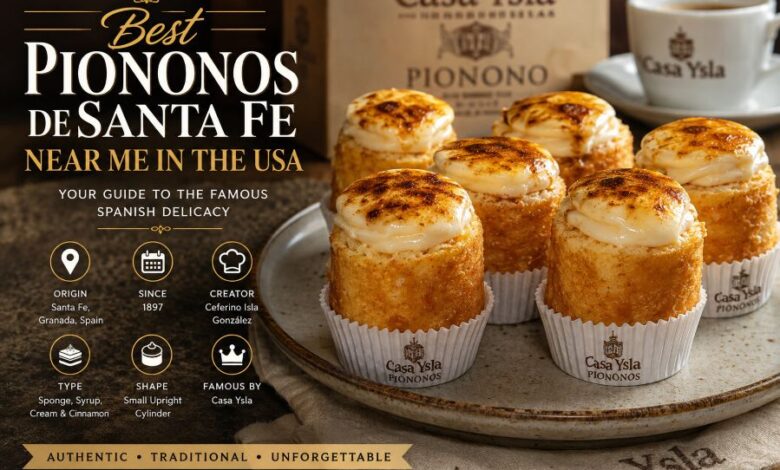
Search “best Piononos de Santa Fe near me” in the United States and you may get plenty of tempting results. There is one catch.
Many of them are not selling the Spanish pastry you searched for.
The original Pionono de Santa Fe comes from Santa Fe, a town in Granada, Spain. It is a tiny upright roll of moist sponge, syrup, cream, cinnamon and a toasted cream crown. It is strongly associated with Casa Ysla and pastry maker Ceferino Isla González, who created the recognizable modern version in 1897.
In the U.S., the word pionono can lead you toward Peruvian, Argentine, Puerto Rican or other Latin American desserts. Some are large rolled cakes. Others use dulce de leche. They may be excellent pastries, but they are not the same thing as a Pionono de Santa Fe from Granada.
So, can you find the real one in America?
Possibly through a specialist Spanish baker or importer, but the search requires more checking than simply typing “pionono near me.” As of August 2026, I could not verify an official Casa Ysla retail location in the United States through Casa Ysla’s published location and product information.
Quick Facts About Piononos de Santa Fe
| Fact | Details |
|---|---|
| Pastry name | Pionono de Santa Fe |
| Origin | Santa Fe, Granada, Spain |
| Modern form created | 1897 |
| Creator | Ceferino Isla González |
| Historic bakery | Casa Ysla |
| Named after | Pope Pius IX, known as Pío Nono |
| Shape | Small upright cylinder |
| Main elements | Sponge, syrup, cream, cinnamon and toasted cream |
| Typical size | Small individual pastry |
| Best-known location | Santa Fe and Granada, Spain |
| Official U.S. Casa Ysla shop | None verified as of August 2026 |
| Common U.S. search problem | Latin American piononos may appear instead |
| Best U.S. buying approach | Check specialist Spanish bakeries and confirm the pastry style before ordering |
What Is a Pionono de Santa Fe?
A Pionono de Santa Fe is small. Very small.
That is one of the easiest ways to distinguish it from many pastries carrying the pionono name elsewhere.
The traditional Granada sweet starts with thin sponge cake. The sponge is moistened with syrup, given a layer of cream and cinnamon, rolled tightly, cut into short portions and stood upright. A cap of sweet cream sits on top and is toasted until its surface develops a lightly caramelized finish.
Casa Ysla says its piononos are made daily in Santa Fe and sent fresh to its pastry shops and restaurant customers. The company describes the production as retaining a substantial handmade element even as demand has grown.
The result is rich but compact.
You get moist sponge first. Then cream. Cinnamon comes through without turning the pastry into a spice cake. The browned top adds a darker sugar note that changes the final bite.
It isn’t supposed to eat like a dry cake roll.
Where Did the Pionono de Santa Fe Come From?
The strongest documented origin story takes us to Santa Fe, Granada, in 1897.
According to the tourism authority of Santa Fe, Ceferino Isla González created the pastry there and based its appearance on Pope Pius IX. The Pope was also known as Pío Nono, which explains the name.
The shape carried meaning too.
Casa Ysla describes the squat cylindrical sponge as a representation of the Pope’s figure, while the sweet toasted cream at the top recalls his skullcap. The white paper surrounding the cake was part of the visual reference to papal clothing.
What began as a local confection became closely tied to Granada’s food identity.
By 2025, El País reported that Casa Isla was producing about 50,000 piononos per week. Other pastry makers across Santa Fe and Granada now produce their own versions as well.
That last detail matters.
Casa Ysla is the historical reference point, yet pionono culture in Granada is larger than a single bakery. The Santa Fe tourism authority itself lists several local producers.
Can You Buy Authentic Piononos de Santa Fe in the USA?
This is where the answer becomes less convenient.
I found no verified official Casa Ysla store in the United States during research conducted in August 2026.
Casa Ysla’s current product catalog lists boxes containing six and twelve piononos, while its own material describes production in Santa Fe and distribution through its shops and restaurant clients. Current reporting also points to distribution within Spain, including Granada and other Spanish regions.
I found no official Casa Ysla statement confirming routine U.S. shipping.
That does not mean nobody in America can make the pastry.
A Spanish bakery, independent pastry chef or specialty food business may prepare a Santa Fe-style pionono locally. Availability can change quickly, especially in large food markets such as Miami, New York, Los Angeles, Chicago and other cities with international bakery scenes.
The safest approach is to verify what the shop means by pionono before placing an order.
Why “Pionono Near Me” Gives Different Desserts in America
The name travelled.
That is the source of most of the confusion.
Several countries developed desserts called pionono, and their recipes do not necessarily resemble the Granada pastry.
A U.S. bakery may describe its pionono as a large vanilla sponge roll filled with dulce de leche and covered with powdered sugar. That is a familiar Latin American interpretation. One established Miami-area bakery describes its pionono in exactly that style.
The Santa Fe version looks very different.
It is small and upright, rather than presented as a long horizontal roulade. Cream and syrup are central to its character, while its toasted cream crown is one of the easiest visual clues.
Dulce de leche does not define the classic Santa Fe pastry.
This difference can save you a disappointing order.
If you specifically want the Granada sweet, searching only “pionono near me” is too broad.
Try “Pionono de Santa Fe near me,” “Spanish pionono Granada near me,” or “Granada Spanish bakery near me.”
Then check the product description.
How to Recognize a Santa Fe-Style Pionono
Photos tell you a lot.
A bakery selling something close to the traditional Granada version should normally show a small cylindrical pastry standing vertically. You should be able to see rolled sponge around the sides and a creamy top with a browned or caramelized surface.
Before ordering, ask the bakery whether its version includes:
- Small rolled sponge portions served upright
- Syrup-moistened sponge rather than a dry cake roll
- Cream inside the roll
- Cinnamon or a similar traditional aromatic note
- Cream placed on top and toasted or caramelized
If the answer is a long sponge roll stuffed heavily with dulce de leche, you have probably found a different pionono tradition.
Nothing is wrong with that dessert.
It just is not what someone searching for Piononos de Santa Fe is usually trying to find.
What Does a Real Pionono de Santa Fe Taste Like?
Sweet, soft and intensely moist.
The size keeps it manageable.
The sponge carries syrup, giving the pastry a moist texture without turning it into pudding. Cream brings richness. Cinnamon cuts through the sugar. Then the toasted top gives the finish a slightly caramelized edge.
Casa Ysla keeps the exact proportions of its recipe private.
Reporting from El País in 2025 described a production process using egg, flour, sugar and several starches, followed by syrup, cream and cinnamon before rolling. A cream cap and sugar are then added before the top is toasted.
Different Granada bakeries have their own methods.
Javier Robles of Obrador Robles told El País that producers have individual tricks involving elements such as syrup preparation, cinnamon and aromatic notes.
So there is no need to treat every variation as fake.
The better question is whether it belongs to the Santa Fe style.
Casa Ysla and the Original Pionono
If your trip ever takes you to Granada, the search becomes much easier.
Casa Ysla remains the name most closely connected with the original modern Pionono de Santa Fe. The business traces its pastry history to Ceferino Isla’s 1897 shop and continues to make piononos in Santa Fe.
The company’s main operation is on the Santa Fe-Granada A92-G road, while Casa Ysla also has pastry shops in Granada.
There are other respected Santa Fe producers.
The town’s official tourism site currently identifies Casa Ysla, Rey Fernando, Robles and Puerta Bernina among local artisan pastry businesses connected with pionono production.
For a food traveler, that opens up a better experience than simply trying one pastry.
Taste the historical reference. Then try another local interpretation.
You will quickly notice how much difference syrup, cream texture, cinnamon and browning can make in something barely larger than a few bites.
Is Casa Ysla the Only Place That Makes Real Piononos?
No.
This is a common oversimplification.
Casa Ysla has the historical connection to Ceferino Isla and describes its product as the original Pionono de Santa Fe. Yet the municipality of Santa Fe confirms that several local pastry makers now produce adaptations and their own versions.
Granada city has its own pionono culture too.
The pastry became so strongly associated with the province that bakeries outside Santa Fe began preparing it, while chefs, ice-cream makers and dessert businesses created products based on its flavors.
The original still sets the reference point.
It does not hold the entire category by itself.
Are Piononos de Santa Fe the Same as Swiss Rolls?
Not really.
They share one obvious technique: thin sponge cake is rolled.
That is where the comparison starts breaking down.
A Swiss roll is usually sliced horizontally from a larger roulade. The Santa Fe pionono is shaped into a small individual cylinder, placed upright and crowned with toasted cream.
The syrup changes the texture too.
Think of the Swiss-roll comparison as a visual shortcut, not a proper definition.
Are They the Same as Peruvian Piononos?
No.
This distinction is especially relevant for people searching in the United States.
Peruvian-style piononos commonly appear as rolled sponge cakes filled with dulce de leche or manjar. They are much easier to encounter in American cities with strong Latin American communities.
For example, a Miami-area bakery’s published menu describes its pionono as a moist vanilla sponge roll filled with homemade dulce de leche and dusted with powdered sugar.
That sounds good.
It is simply a different dessert from the small cream-crowned pionono associated with Santa Fe, Granada.
What Should You Pay for Piononos in the USA?
There is no reliable national U.S. price for authentic Piononos de Santa Fe because there is no verified nationwide retail network for the Spanish version.
Prices from Latin American pionono sellers should not be used as a benchmark either. Those shops may be selling a different product, often in a much larger format.
Imported pastries would also carry costs that do not reflect what customers pay at a bakery in Granada.
If a U.S. seller claims to import Casa Ysla piononos directly, ask where the product comes from and how it is transported before paying an import premium.
Freshness matters with a syrup-and-cream pastry.
What About Santa Fe, New Mexico?
Here is another easy search trap.
Piononos de Santa Fe do not originate in Santa Fe, New Mexico.
The Santa Fe in the pastry’s name is Santa Fe in Granada Province, Andalusia, Spain.
American local search engines can interpret “Santa Fe near me” geographically and send users toward New Mexico businesses. That search behavior does not change the food’s origin.
For better results in the U.S., include “Granada Spain” or “Spanish pastry” with the search.
Are Piononos Worth Trying?
Yes, especially if you like syrup-soaked European pastries.
They offer quite a lot in a small package.
What makes the Santa Fe pionono memorable is not an oversized filling or elaborate decoration. The appeal comes from the balance between moist cake, cream, cinnamon and toasted sugar, plus the history tied to one specific Andalusian town.
That history is still alive.
More than a century after Ceferino Isla started selling the pastry, bakeries in Santa Fe continue making their own versions, while Casa Ysla remains closely associated with the original form.
Final Thought
Searching for the best Piononos de Santa Fe near me in the USA requires a little skepticism.
A nearby pionono may be delicious and still have almost nothing in common with the pastry from Granada.
Start with the shape. Look for a tiny upright sponge roll, syrup-softened and finished with toasted cream. Check the ingredients. Ask whether the bakery is making the Spanish Santa Fe style rather than a dulce de leche roll.
If no local baker offers it, that is better than pretending an unrelated pastry is the same thing.
And if you ever reach Santa Fe, Granada?
Try one there.
That is where the story began.
Frequently Asked Questions
What are Piononos de Santa Fe?
Piononos de Santa Fe are small Spanish pastries made from rolled sponge, syrup, cream, cinnamon and a toasted cream topping. Their modern form originated in Santa Fe, Granada.
Where can I find the best Piononos de Santa Fe near me in the USA?
No official nationwide U.S. Casa Ysla network was verified as of August 2026. Check specialist Spanish bakeries and confirm they make the Granada-style pastry before ordering.
Are Piononos de Santa Fe from New Mexico?
No. The name refers to Santa Fe in Granada, Spain, not Santa Fe, New Mexico.
Are Spanish piononos made with dulce de leche?
Dulce de leche is common in several Latin American pionono styles. It is not the defining filling of the traditional Santa Fe, Granada version.
Who invented the Pionono de Santa Fe?
The municipality of Santa Fe and Casa Ysla credit Ceferino Isla González with creating the recognizable modern pastry in 1897.
Why is it called a pionono?
The name refers to Pope Pius IX, known as Pío Nono. Ceferino Isla also designed the pastry’s appearance as a culinary tribute to the Pope.
Is Casa Ysla the only bakery making Piononos de Santa Fe?
No. Casa Ysla is historically associated with the original modern version, while several bakeries in Santa Fe and Granada produce their own interpretations.
Can Casa Ysla piononos be shipped to the United States?
I found no official confirmation of regular U.S. shipping on Casa Ysla’s current published information as of August 2026. Check directly with the company before relying on third-party sellers.