Extroly Com: What Is This Website Really About?
Extroly.com has attracted several different descriptions online. Here is what its published content, website structure, and guest-post listing actually tell us.

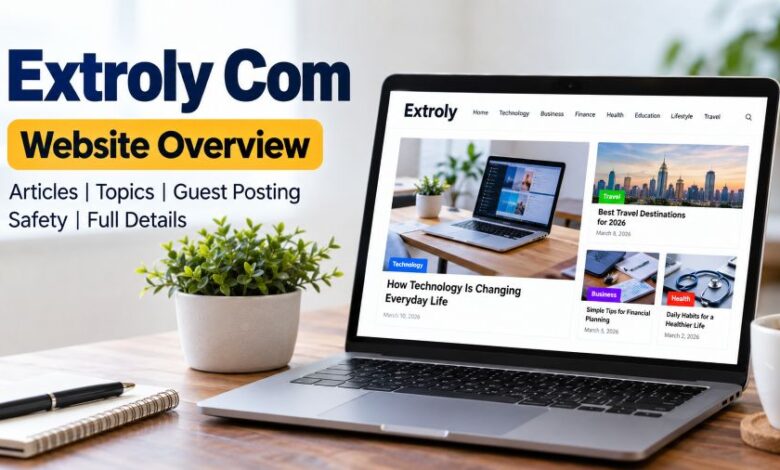
Extroly Com is a general-interest content website. It publishes articles about technology, business, finance, health, education, travel, and lifestyle. The website works much like an online magazine, with posts covering different subjects.
But there is some confusion.
Search for Extroly.com, and you may find articles calling it a social networking platform or an AI-powered workspace. Those descriptions sound interesting. Still, available website inspections don’t support those claims.
The evidence points to something simpler: a WordPress-based publication with an advertised connection to guest-post publishing.
So, what can readers actually expect? And how reliable is the information available about the website?
Quick Facts
| Detail | Information |
|---|---|
| Website name | Extroly |
| Domain | Extroly.com |
| Website type | General-interest content website |
| Main purpose | Publishing informational articles |
| Main language | English |
| Content system | WordPress, according to website inspections |
| Reported website theme | Newspaperup |
| Main topics | Technology, business, finance, health, education, travel |
| Other topics | Lifestyle, automotive, fashion, general information |
| Reported article byline | Adoosylinks |
| Earliest reported archive entries | March 2021 |
| Guest posting | Advertised by a third-party marketplace |
| Founder | Not publicly verified |
| Official mobile app | Not verified |
A Closer Look at the Website
Extroly.com is built around written content.
Visitors can find articles covering several subjects. Some discuss technology. Others focus on money, travel, household needs, or everyday questions.
That is a fairly common publishing model.
Instead of covering one specialist subject, a general-interest website can publish different stories for different readers.
Someone interested in banking technology might find a relevant article. Another visitor might arrive while searching for travel information.
Both can reach the same website.
Published inspections describe a traditional magazine-style WordPress layout. The reported design uses a category menu, article previews, recent-post areas, and archives.
There is no verified evidence that the website operates as a full social media service or project management application.
That distinction matters.
What Topics Does the Website Cover?
The reported category structure covers several broad subjects.
Technology
Technology is one of the website’s main categories.
Previously inspected articles have discussed banking application security and technology used in accounting.
These topics can interest readers who want simple explanations of software, online services, and technology-related issues.
Still, an article appearing in a technology category does not automatically make it expert advice.
Readers should check important claims carefully.
Business and Finance
Business and finance also appear in the site’s category structure.
Reported article subjects include accounting careers, property development, and cryptocurrency price tracking.
Money-related information needs extra care.
Financial figures can change quickly. Market information may become outdated, even when an older article remains available.
So, readers should check publication dates and compare important figures with current, reliable records.
Health and Education
Health and education are listed among the website’s subjects.
These categories can cover questions that readers search for during everyday life.
But there is a difference between general information and professional advice.
A health article should not replace advice from a qualified medical professional. Educational claims also deserve checking, especially when they concern qualifications or official requirements.
Travel and Lifestyle
Travel and lifestyle topics form another part of the publication.
Previously reported article subjects include moving services in Dubai, flight booking, and household buying decisions.
These subjects are practical.
Readers may be looking for a basic answer, comparing available choices, or trying to understand a service before spending money.
The quality of each article matters more than the category name.
How Is the Content Organised?
The website has been described as using WordPress, with a Newspaperup magazine theme.
Its layout follows a familiar blog format.
Readers see article titles and can browse different categories. Archived posts provide access to older content.
This setup suits websites publishing across many subjects.
It also keeps the reading process simple.
Visitors do not need an advanced dashboard to read a normal blog article.
Website inspections have reported ten content categories, although the exact menu and available posts may change as the publisher updates the site.
The main question is whether each article gives readers accurate, useful information.
A neat design alone cannot answer that.
Publishing History and Older Articles
Extroly.com has a reported archive history reaching back to March 2021.
Other inspected archive periods include parts of 2023, 2025, and 2026.
That suggests content has appeared under the domain across several years.
However, an archive date is not the same as a domain registration date.
It also does not prove that the website has operated continuously under the same ownership.
There may have been publishing gaps.
For readers, checking an article’s date is a useful habit. An older travel article may contain prices or policies that have changed. Technology information can become outdated too.
A recent publication date helps, but accuracy still needs checking.
The Guest Post Connection
This is one of the more clearly documented commercial aspects of the website.
Extroly.com appears in the Adoovy guest-post marketplace.
The marketplace advertises paid article publication on the domain. Its listing describes placements in subjects such as finance, health, and technology.
At the time of this research, the listing advertised a price of $90, with a claimed publishing turnaround of 24 to 48 hours.
Those are marketplace terms.
They should not be treated as confirmed direct-publisher policies.
The listing also advertises permanent posts and dofollow backlinks. Anyone considering a placement should confirm the actual terms with an authorised representative before paying.
Why Would Someone Publish a Guest Post?
Guest posting is a familiar online publishing practice.
A writer or business prepares an article for another website. The purpose might be to share useful information, reach new readers, or bring attention to a business.
Some placements are unpaid. Others are sponsored.
The distinction should be clear.
For paid articles, publishers and advertisers should follow applicable disclosure requirements and search-engine rules.
Google’s link-spam policies warn against buying links primarily to manipulate search rankings.
Paid links should use suitable attributes, such as sponsored or nofollow.
A purchased article is not a guaranteed ranking improvement.
What Do Its Advertised SEO Metrics Mean?
The Adoovy listing reports several SEO figures for the domain.
| Metric | Marketplace-reported figure |
|---|---|
| Moz Domain Authority | 50 |
| Ahrefs Domain Rating | 71 |
| Ahrefs traffic estimate | 138 |
| Semrush traffic estimate | 595 |
These figures come from a third-party marketplace listing. They are not independently audited measurements for this article.
And they need context.
Domain Authority and Domain Rating are third-party SEO measures. Neither represents a direct Google ranking score.
Traffic estimates also differ between SEO tools.
A domain may have a high backlink score but attract relatively few estimated organic visitors.
That is why marketers should check real audience relevance, article quality, search visibility, and outbound links before choosing a publishing website.
Numbers alone tell only part of the story.
Is It an AI or Social Networking Platform?
Several online descriptions make this question confusing.
Some articles claim that Extroly offers AI-based interest matching. Others describe private messaging, user communities, creator dashboards, and collaboration tools.
But these features have not been demonstrated by the inspected website.
Instead, published homepage reviews describe a content blog.
No verified product documentation was established for the claimed social networking system.
That does not prove every possible feature is absent.
It means there is not enough reliable evidence to present those features as genuine services.
Readers looking for an AI productivity tool should check for official product pages, working features, and clear documentation before relying on promotional descriptions.
The name of a website cannot confirm its purpose.
Its actual functions matter.
Who Owns the Website?
Publicly verifiable ownership information remains limited.
The available research does not establish a confirmed founder, registered company, headquarters, or named editorial leadership.
Previously inspected articles reportedly carried the author name Adoosylinks.
But an article byline is not proof of legal ownership.
The website’s association with an outside guest-post marketplace does not establish who owns the domain either.
These details should stay separate.
Claiming that a particular individual founded the website without reliable records would be misleading.
For now, the ownership question remains unanswered.
Is the Website Safe and Legitimate?
Extroly.com has a documented history as a content website, and an outside marketplace advertises publication on the domain.
That establishes a public publishing presence.
It does not establish complete security or reliability.
No conclusive evidence in this research justifies calling the website a scam. There is also not enough evidence to guarantee that every article, advertisement, or publishing offer is trustworthy.
Readers should use ordinary online safety habits.
Check unfamiliar links before opening them. Avoid suspicious downloads. Don’t enter payment information into a form unless you have verified who operates it.
Pay extra attention to financial or medical claims.
One poorly researched article can create confusion, even on a website that otherwise looks professional.
What About Privacy?
A website’s privacy practices cannot be judged from its appearance alone.
Users should read its current privacy notice before sharing personal details.
The research available here does not establish its full data-handling practices, security arrangements, or account protections.
It would be wrong to promise privacy features without evidence.
What Should Writers Check Before Buying a Placement?
A guest-post listing can be useful for finding publishing opportunities.
Still, writers should investigate the website before spending money.
Here are some practical checks:
- Read recent articles. Look for original writing, accurate facts, and clear formatting.
- Check topic relevance. A link should make sense within the surrounding article.
- Review search visibility. High authority scores do not guarantee active readers.
- Confirm publisher approval. A third-party listing should not replace verification.
- Ask about link treatment. Paid links need appropriate disclosure and attributes.
- Check the payment terms. Understand refunds and publication conditions before ordering.
- Review existing outbound links. Too many unrelated promotional links can be a warning sign.
These checks apply to any website selling sponsored publishing opportunities.
They are especially useful when ownership and editorial information are limited.
What Makes the Website Different From Specialist Blogs?
A specialist blog concentrates on one main subject.
Extroly.com has been observed covering many.
That wider subject range can appeal to different search audiences.
But it creates a challenge.
Readers may want a qualified finance writer for money questions and a trained health professional for medical topics. The expertise needed for each subject is different.
So, readers should judge the author and evidence behind each article.
A website can publish useful content across many categories. Still, broad coverage does not establish expertise in every category.
The article itself has to earn that trust.
Who Might Find It Useful?
The website may interest readers searching for general information on business, technology, travel, lifestyle, or other everyday subjects.
It may also attract writers researching websites that advertise guest-post placements.
Those are two different uses.
A reader mainly needs accurate content. A business considering paid publication needs to check audience quality, publishing terms, and compliance.
For someone looking for a social networking application, the evidence is much weaker.
No verified social media product has been established through this research.
What Information Is Still Missing?
Some questions remain open.
The exact original launch date is not confirmed. A verified founder and legal owner have not been established.
Current independently audited traffic figures are unavailable.
There is also no verified official mobile application or documented social networking service.
These gaps should not be filled with guesses.
A reliable website review explains what is known and makes the limits clear.
That gives readers a better basis for deciding what to trust.
Final Thought
Extroly.com is best understood as a general-interest content website.
Its reported WordPress structure, article categories, publishing archive, and outside guest-post listing support that description.
Claims about AI tools and social networking features remain unsupported by the available evidence.
For ordinary readers, the main task is simple: check the quality and accuracy of the article you are reading.
For marketers, the decision needs more work. Review the publishing terms, audience relevance, and link practices before paying for a placement.
The website has a documented publishing presence. But several ownership and operational details still need independent confirmation.
Frequently Asked Questions
1. What is Extroly.com?
Extroly.com is a general-interest content website. It publishes informational articles across subjects such as technology, finance, business, health, education, and travel.
2. What is the main purpose of the website?
Its documented activity centres on publishing written articles. A third-party marketplace also advertises guest-post placements on the domain.
3. Who is the founder?
The founder has not been independently verified through reliable public information.
4. Does it accept guest posts?
Adoovy advertises paid article placements on the domain. Writers should confirm the current terms and publisher authorisation before ordering.
5. Is it a social networking website?
Available website inspections support its identity as a blog. Claims about profiles, messaging, and social networking features have not been verified.
6. Does it have an official app?
No official Android or iOS application has been independently verified in this research.
7. Is the website safe to visit?
There is not enough evidence to guarantee its security or classify it as fraudulent. Visitors should follow standard browsing precautions and verify important information.
8. Can a backlink from the website improve SEO?
No backlink guarantees better search rankings. Any benefit depends on factors such as relevance, quality, and search-engine treatment. Paid links must follow Google’s policies.