HexClad Reviews: What Long-Term Tests Really Say About the Cookware
HexClad looks different from a normal frying pan, costs a lot more, and promises a mix of stainless-steel cooking and nonstick convenience. But does that hybrid idea actually work after months of use?

Introduction
HexClad has become hard to ignore.
You see the hexagon cooking surface. Gordon Ramsay talks about it. Social media clips show eggs sliding around and steaks getting a dark crust.
Then you see the price.
That changes the question fast.
People searching for HexClad reviews usually want to know one thing: does this cookware actually deserve its premium price?
The answer needs some context.
Independent testers have praised HexClad for browning, heat control, easy cleanup, and its ability to handle many cooking jobs. Yet long-term nonstick performance gets mixed reports.
So, basically, HexClad does some things very well. It also has limits that buyers should know before spending hundreds of dollars.
Quick Facts About HexClad
- Product type: Hybrid cookware
- Cooking surface: Raised stainless-steel pattern with coated recessed areas
- Current coating: TerraBond ceramic nonstick
- Current coating claim: Free from PTFE, PFAS, lead, and cadmium
- Induction compatible: Yes
- Metal utensil safe: Marketed as yes
- Dishwasher safe: Yes, though hand washing can be gentler
- Seasoning recommended: Yes
- Warranty: Lifetime against manufacturing defects on cookware
- Best known for: Fry pans, woks, pots, and cookware sets
- Price level: Premium
- Main strength: Browning plus easier food release
- Main complaint: Nonstick performance can change with time
HexClad says its current TerraBond coating uses a proprietary ceramic formula and is free from PTFE, PFAS, lead, and cadmium.
What Is HexClad Cookware?
HexClad is a hybrid cookware system.
That word matters.
It is not a normal stainless-steel pan. It is not a standard smooth nonstick pan either.
Look closely at the cooking surface.
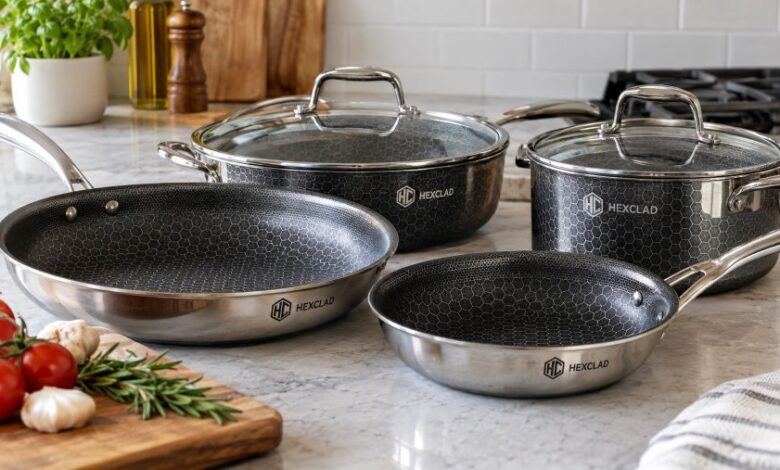
You will see raised stainless-steel hexagons. Coated areas sit between those raised sections.
The basic idea is simple.
The stainless steel gives food more contact with metal. That can help create stronger browning and searing.
The coated areas make food easier to release.
You get a middle ground.
That is basically the whole HexClad concept.
Traditional nonstick cookware can feel slicker. Stainless steel can usually take tougher cooking conditions. HexClad tries to sit somewhere between the two.
Does HexClad Actually Work?
Yes, it can.
But technique matters.
Good Housekeeping published a 2026 review after using HexClad cookware with the newer coating for more than a year.
The tester reported good results with eggs, salmon, chicken, steak, vegetables, stir-fries, pasta, soups, and other foods.
Eggs cooked with oil still released well after a year. Chicken browned evenly too.
That is a strong result.
Still, there is another side.
Bon Appétit tested HexClad and raised concerns about the long-term performance of ceramic nonstick cookware. Its September 2026 review found that fresh cookware performed reasonably well, but older pieces showed more sticking.
So both things can be true.
A HexClad pan can cook very well.
Its coated surface may still become less slippery as it ages.
HexClad Nonstick Performance
This is probably the biggest part of the debate.
People hear “nonstick” and picture an egg skating around a dry frying pan.
HexClad does not always work like that.
A little oil helps.
Actually, HexClad itself recommends seasoning the cooking surface before regular use.
That should tell buyers something.
This cookware is not really aimed at zero-fat cooking.
Independent tests also back that up. Good Housekeeping found strong food release while cooking with some fat.
For eggs, pancakes, fish, and other delicate foods, low or medium-low heat generally makes more sense.
Too much heat can work against you.
Does HexClad Need Oil?
Usually, yes.
You do not need huge amounts.
A thin layer may be enough.
Still, buyers expecting completely dry cooking could be disappointed.
This is one of the main differences between HexClad and a classic smooth nonstick skillet.
Traditional nonstick can feel slicker.
HexClad trades some of that slipperiness for a surface that can brown food better.
Think about the cooking you actually do.
That matters more than advertising clips.
How Well Does HexClad Sear Meat?
This is where the cookware makes a stronger case.
Steak needs contact.
Chicken needs browning.
Salmon skin benefits from heat moving into the food quickly.
The stainless-steel areas of HexClad give meat a surface that behaves differently from a fully coated nonstick pan.
Good Housekeeping reported evenly browned chicken during long-term testing.
Bon Appétit also found that HexClad could produce decent searing in testing, even though the publication was much more critical about the cookware’s price and long-term coating life.
This is an important point.
You do not have to agree with a reviewer’s final opinion to learn from the actual test results.
The cooking performance itself was not the biggest complaint.
Longevity and value were.
Current HexClad TerraBond Coating
This part can get confusing because older reviews and newer reviews may be talking about different cookware.
Current HexClad cookware uses TerraBond ceramic nonstick.
HexClad says this proprietary formula is free from:
- PTFE
- PFAS
- lead
- cadmium
That information comes directly from the company’s current support material.
Older HexClad cookware used a different coating system.
So you should check the date when reading reviews.
A complaint about an older model may still tell you something about the brand’s history, but it does not automatically describe the current TerraBond cooking surface.
What Happened With the HexClad Lawsuit?
Yes, there was a class-action case involving earlier HexClad products.
The lawsuit alleged that HexClad made misleading claims about the coating used on certain products, including statements related to PFAS, PFOA, and toxicity.
HexClad denied wrongdoing.
The settlement applied to eligible products purchased between February 1, 2022 and March 31, 2024. Court documents show that final approval of the settlement was granted.
The settlement fund was listed at $2.5 million.
Settlement terms also stated that HexClad would stop marketing products containing PTFE or another chemical in the PFAS family using certain PFAS-free, PFOA-free, or non-toxic claims.
This needs careful wording.
The lawsuit involved previous products and marketing claims.
It does not prove that HexClad’s current TerraBond coating contains PFAS.
Current HexClad information says TerraBond is free from PTFE and PFAS.
HexClad Durability
There are two separate questions here.
First: is the pan body durable?
Generally, yes.
HexClad cookware feels much tougher than thin budget nonstick cookware.
The construction is one reason the pans feel heavier.
Second: will the nonstick effect stay exactly the same forever?
That is much harder to promise.
Ceramic coatings can lose some food-release performance as they age.
That concern appears in Bon Appétit’s long-term discussion of HexClad.
Good Housekeeping had a better long-term experience and reported that eggs with oil were still releasing after more than a year.
That difference explains why HexClad owner opinions can look so divided.
Cooking heat matters.
Cleaning matters.
Utensils matter.
Frequency of use matters too.
Can You Use Metal Utensils on HexClad?
HexClad markets its cookware as metal-utensil safe.
The raised stainless-steel pattern gives the coated sections some protection.
That does not mean the surface cannot be damaged.
Sharp edges are still sharp.
Dragging a knife around a pan is a bad idea.
You can use metal utensils more freely than you might with a normal smooth nonstick frying pan, but wood, silicone, and other softer tools are still sensible if you want to reduce wear.
Is HexClad Dishwasher Safe?
Yes.
But there is a difference between “safe” and “best for long life.”
Good Housekeeping recommends more hand washing and drying rather than depending heavily on the dishwasher.
Hand washing is easy enough for most daily mess.
Use warm water.
Use normal dish soap.
Then use a soft sponge.
Pretty simple.
Cooked-on oil may need more work.
Is HexClad Good for Induction Cooktops?
Yes.
HexClad cookware supports induction cooking.
It also works with common gas and electric cooking surfaces.
That makes it useful for homes where the cooktop may change later.
Induction compatibility is a real plus because not every nonstick pan works on induction.
Does HexClad Get Too Hot?
It can.
That is why heat control matters.
Good Housekeeping noted that HexClad advises users to start at lower temperatures and raise the heat only when needed.
The same review points out that damage from excessive heat may affect warranty coverage.
So blasting the burner at maximum heat every day is not a smart way to treat these pans.
Medium works for a lot of cooking.
Lower heat works for eggs.
Higher heat may be useful for selected browning jobs, but it should not become the default setting.
HexClad Warranty Explained
HexClad advertises a lifetime warranty on its cookware.
Sounds simple.
The details matter.
The warranty covers manufacturer’s defects.
HexClad says damage caused by things such as excessive heat, neglect, improper storage, sharp-utensil misuse, improper cleaning, improper seasoning, or commercial foodservice use is not covered.
Normal cosmetic wear is excluded too.
The warranty is also tied to the original purchaser or original gift recipient and requires proof of purchase.
So “lifetime warranty” does not mean every damaged pan automatically gets replaced.
Read the care instructions.
Keep the receipt.
That can save trouble later.
How Much Does HexClad Cost?
It is expensive cookware.
There is no getting around that.
At the time of this article, HexClad’s U.S. website listed examples including:
- 12-inch Hybrid Fry Pan with lid — $199
- 14-inch Hybrid Wok with lid — $219
- 7-quart Hybrid Deep Sauté Pan — $229
- 6-piece Hybrid Pot Set — $379
Prices can change due to sales and promotions.
That premium pricing changes how buyers judge small problems.
A minor annoyance on a $30 pan may feel acceptable.
At $199, expectations rise.
Fast.
Main Benefits of HexClad
HexClad has several clear strengths.
Good browning
The stainless-steel pattern helps create better browning than many regular nonstick pans.
Easier food release
It is usually more forgiving than bare stainless steel, especially with some oil.
Works on induction
Useful for many kitchens.
Solid construction
The cookware feels substantial.
Flexible daily use
You can cook eggs, vegetables, fish, meat, sauces, and many normal meals without constantly changing pans.
Cleanup is usually easy
Proper heat and some cooking fat can keep food from becoming a hard-to-remove mess.
Common HexClad Complaints
The biggest complaint is price.
No surprise there.
Another common issue is sticking.
Some buyers expect standard nonstick behavior and find they need more oil than expected.
Weight can also be an issue.
These pans are not feather-light.
The handle shape gets mixed comments too. Good Housekeeping reported that the rounded handle can rotate somewhat while pouring, especially with a wet hand or oven mitt.
Then there is coating life.
Some long-term testers report good performance.
Others report more sticking with age.
That is probably the issue buyers should watch most closely.
HexClad vs Traditional Nonstick
A normal quality nonstick pan usually wins on pure slipperiness.
Eggs can release with very little oil.
The pan is often lighter too.
HexClad wins more points for browning and its tougher cooking surface.
So ask yourself what matters.
Want the easiest possible egg pan?
Standard nonstick may make more sense.
Want one pan that can fry an egg in the morning and brown chicken later?
HexClad becomes more interesting.
HexClad vs Stainless Steel
Stainless steel can last for decades.
There is no nonstick coating that needs to stay slippery.
It handles serious cooking.
The trade-off is technique.
Food can stick badly if you get the temperature wrong.
HexClad is easier for many home cooks.
You get some stainless-steel-style browning with a surface that is usually easier to clean.
But stainless steel still has the edge for people who want cookware without a ceramic nonstick layer.
HexClad vs Cast Iron
Cast iron is tough.
Very tough.
A good skillet can last generations.
It can also be heavy, slow to heat, and more demanding to maintain.
HexClad feels easier day to day.
Cleaning is simpler.
Rust is less of a concern.
But cast iron has no ceramic cooking coating that needs to keep its factory nonstick performance.
These are very different products.
Is HexClad Good for Eggs?
Yes, with the right method.
Use lower heat.
Use some oil or butter.
Give the pan time to heat properly.
Good Housekeeping found that eggs fried with oil still released easily after more than a year of use.
That is encouraging.
Still, do not expect every egg to behave like it is cooking on a brand-new traditional nonstick pan.
Is HexClad Worth the Money?
That depends on what you expect from it.
HexClad makes sense for people who want fewer pans and like mixing different cooking styles.
You can fry.
You can sear.
You can sauté.
You can handle delicate foods.
Cleanup is usually manageable too.
But the price is high.
If your main goal is cooking eggs, buy a good standard nonstick pan.
If your main goal is hard searing and decades of use, stainless steel, cast iron, or carbon steel may suit you better.
HexClad becomes easier to justify when you specifically want the middle ground.
That is its real selling point.
Who Should Consider HexClad?
HexClad may fit your kitchen if you:
- cook meat often
- want easier cleanup than stainless steel
- use an induction cooktop
- do not mind using some oil
- prefer one pan for many jobs
- are comfortable paying more
- understand that ceramic nonstick performance can change over time
Who Should Skip It?
Think twice if you:
- want very cheap cookware
- need an extremely lightweight pan
- expect perfect oil-free egg cooking
- frequently cook everything at maximum heat
- expect a coated pan to stay factory-new forever
- only need a basic nonstick skillet
There are cheaper choices for those jobs.
Final Thought
HexClad is not fake cookware, and it is not a miracle pan either.
That middle point matters.
Independent testing shows that the cookware can brown meat well, release delicate foods with proper heat and cooking fat, and stay useful during regular home cooking.
Still, the price is serious.
Long-term ceramic nonstick performance remains the main question.
Current TerraBond cookware also needs to be separated from older HexClad models because the coating has changed.
Basically, know what you are buying.
HexClad works best as hybrid cookware.
Treat it that way.
Frequently Asked Questions
Is HexClad really nonstick?
HexClad has a coated cooking surface, but it does not behave exactly like a traditional smooth nonstick pan. Food release is usually better when some oil or butter is used.
Is HexClad PFAS-free?
HexClad says its current TerraBond ceramic coating is free from PTFE, PFAS, lead, and cadmium. This claim relates to the current coating, not every older HexClad product ever sold.
Does HexClad contain Teflon?
Current HexClad information says TerraBond is PTFE-free. Older HexClad products used a different coating, so the age and model of the cookware matter.
Why does food stick to HexClad?
High heat, not enough cooking fat, food placed into the pan too early, or wear on the cooking surface may affect food release.
Can I cook eggs in HexClad?
Yes. Lower heat and a small amount of oil or butter usually give better results. Long-term testing from Good Housekeeping found good egg release after more than a year when oil was used.
Can you use metal utensils with HexClad?
HexClad markets its Hybrid cookware as metal-utensil safe. Still, avoiding sharp scraping and cutting directly inside the pan may help reduce wear.
Does HexClad have a lifetime warranty?
HexClad cookware carries a lifetime warranty against manufacturer’s defects. Damage caused by misuse, excessive heat, improper cleaning, neglect, improper seasoning, or other excluded conditions may not be covered.
Is HexClad worth buying?
It may be worth considering for people who want stronger browning than normal nonstick cookware without dealing with the sticking that can come with stainless steel. Buyers focused mainly on low price or maximum nonstick slipperiness have other good choices.