ScientificAmerican.com Games: What You Can Play and How It Works
A clear look at Scientific American’s puzzle section, including Sudoku, KenKen, Spellements, science crosswords, quizzes, math puzzles, Wordology, jigsaws and more.

Introduction
ScientificAmerican.com Games brings puzzles into a science publication.
That sounds simple. It mostly is.
But the section has more depth than regular browser puzzle pages. Some games connect directly with Scientific American stories. Others pull ideas from mathematics, science news, old magazine covers and even language found inside the publication’s historical archive.
You can play familiar games too.
Sudoku is there. KenKen too.
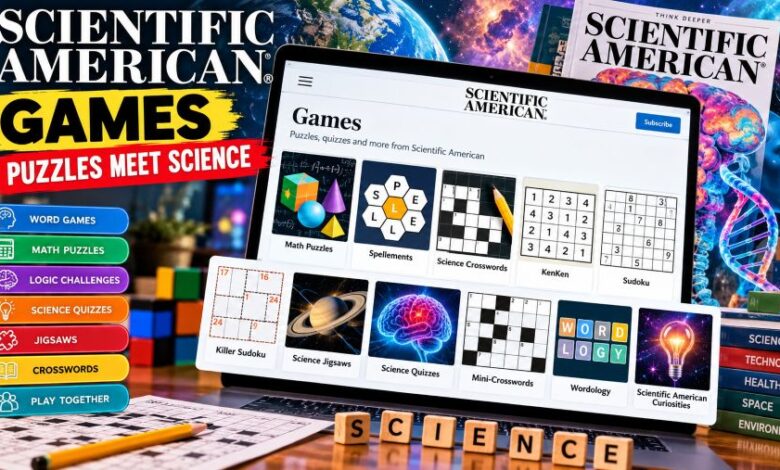
Then things get more specific. Spellements mixes word-building with science content. Wordology uses unusual scientific terms. Science Crosswords connect clues with the magazine, while Math Puzzles give readers problems built around numbers, probability, geometry and logic.
Basically, this is not a video-game portal.
It is a puzzle section.
Quick Facts
| Detail | Information |
|---|---|
| Website | ScientificAmerican.com |
| Section | Scientific American Games |
| Main page | ScientificAmerican.com/games |
| Started | 2024 |
| Main content | Word, math, logic and science puzzles |
| Access type | Browser-based |
| Puzzle provider | Amuse Labs for interactive games |
| Scientific American owner | LabX Media Group |
| Common games | Sudoku, KenKen, crosswords, quizzes, Spellements |
| Feedback email | games@sciam.com |
| Account benefit | Can help save supported game progress |
| Current status | Active |
What Is ScientificAmerican.com Games?
ScientificAmerican.com Games is the official puzzle section of Scientific American.
It sits inside the main ScientificAmerican.com website rather than operating as a separate gaming service.
The project started in 2024.
Scientific American has said senior editor Sarah Lewin Frasier launched the Games section that year. The publication also promoted the section alongside its 2024 Fun and Games digital issue.
That timing makes sense.
Scientific American has a long history with recreational mathematics, logic and puzzle writing. Martin Gardner’s famous Mathematical Games column is one well-known example.
The current Games section brings that idea into a browser.
Readers can solve daily puzzles. They can try weekly challenges. Some games are quick. Others require more work.
And yes, some are tough.
What Games Are Available?
Scientific American currently lists several types of games and puzzle formats.
The main collection includes:
- Math Puzzles
- Spellements
- Science Crosswords
- KenKen 4×4
- KenKen 6×6
- Easy Sudoku
- Medium Sudoku
- Hard Sudoku
- Expert Sudoku
- Killer Sudoku
- Science Jigsaws
- Science Quizzes
- Mini-Crosswords
- Wordology
- Scientific American Curiosities
The publishing schedule varies.
Some puzzles appear daily.
Others arrive weekly or around magazine issues. A few are experimental or mainly kept as archives.
Let us look at them.
Math Puzzles
Math Puzzles are one of the most science-focused areas.
These puzzles can involve:
- numbers
- geometry
- probability
- mathematical patterns
- logic
- spatial thinking
Some are easy to understand.
Solving them is another story.
Scientific American has published Math Puzzles from writers including Jack Murtagh, Heinrich Hemme and Emma R. Hasson.
Historical material linked with Martin Gardner also appears in the wider puzzle coverage.
Recent 2026 pages show that Math Puzzles are still being published regularly.
Many puzzles include a solution section.
So you can try first.
Then check your answer.
That makes the format useful for readers who want more than a score. You can see how the puzzle works and why the answer makes sense.
Spellements
Spellements is Scientific American’s word-building game.
Players receive a group of letters.
One letter sits in the center.
That central letter must appear in every accepted word. Players then build as many words as possible from the available letters.
Letters can be reused.
Simple idea. Hard game.
Some puzzles also include a pangram.
A pangram uses every available letter and gives the player bonus value inside the game.
Scientific American has linked some pangrams with recent science articles, which gives Spellements a direct connection with its editorial content.
The game can include:
- hints
- a timer
- keyboard controls
- mouse controls
- scoring
- pangrams
- article-related words
- Play Together
Scientific American also asks players to report valid scientific words that its dictionary may have missed.
That makes sense here.
Scientific vocabulary gets weird.
Science Crosswords
Science Crosswords take a familiar crossword format and add science-focused clues and themes.
Some puzzles connect with specific Scientific American magazine issues.
That is a key difference.
You are not only getting general trivia.
A crossword may relate to material published in a current issue, including topics from physics, biology, space, language or other science areas.
Recent 2026 examples include puzzles linked with September and October magazine content.
Crossword constructors have included Aimee Lucido and Ella Dershowitz.
The interface may offer features such as:
- Assist
- grid reveal
- clue navigation
- keyboard entry
Some print-related puzzles may also have printable answers.
KenKen 4×4
KenKen 4×4 is a small arithmetic and logic puzzle.
Players fill the grid using numbers 1 through 4.
A number cannot repeat inside a row.
It cannot repeat inside a column either.
Then there are cages.
Each cage has a mathematical target. You need to place numbers that reach that target using the shown operation.
So it mixes arithmetic with logic.
Scientific American identifies KenKen as a trademark of KenKen Puzzle Co.
That means KenKen itself is not a Scientific American invention.
The publication provides it through its Games section.
KenKen 6×6
KenKen 6×6 follows the same basic idea.
But the grid is larger.
Players use numbers 1 through 6.
Rows and columns cannot contain repeated numbers, while the mathematical cages must still meet their target values.
The larger grid raises the difficulty.
More cells. More choices.
More ways to get stuck.
Sudoku
Scientific American offers several standard Sudoku levels.
These include:
- Easy Sudoku
- Medium Sudoku
- Hard Sudoku
- Expert Sudoku
All use the normal 9×9 format.
You fill the grid with numbers 1 through 9.
Each number can appear once per row, once per column and once inside each 3×3 box.
The difficulty changes by puzzle.
Easy is friendlier.
Expert takes more patience.
Scientific American lists these as daily games.
Some Sudoku pages also support Play Together, letting players work on a puzzle with another person.
Killer Sudoku
Killer Sudoku adds arithmetic.
Normal Sudoku rules still apply.
But there is another layer.
Groups of cells sit inside dotted cages. Each cage has a total. The numbers you enter must add up to that total.
Digits cannot repeat inside a cage.
So you are solving two problems at once.
Sudoku logic matters.
Basic arithmetic matters too.
Killer Sudoku also supports collaborative Play Together features on Scientific American.
Science Jigsaws
Science Jigsaws use Scientific American imagery.
The most interesting part is the source material.
Scientific American has more than 180 years of publishing history, and the jigsaw section uses notable covers from that archive.
Players rebuild those images as browser-based jigsaw puzzles.
This gives the game a different feel.
It is visual.
It also works like a small trip through the publication’s history.
Scientific American was still publishing Science Jigsaw content in 2026.
Science Quizzes
Science Quizzes test readers on science news and general scientific topics.
Scientific American describes these as weekly quizzes.
Questions can touch areas such as:
- astronomy
- physics
- biology
- food science
- research findings
- unusual discoveries
Journalist Allison Parshall has written Science Quizzes for the site.
The connection with current reporting matters here.
These are not only textbook questions.
Some quiz material comes from science stories readers may have seen recently.
Mini-Crosswords
Mini-Crosswords have a different status.
Scientific American says the feature was part of a games experiment.
The archive remains available.
But the publication has also asked readers whether they would like Mini-Crosswords to return.
So this section should not be treated as a standard current daily game.
Think of it as an archived experiment.
For now, that description fits best.
Wordology
Wordology is one of the more unusual games on the site.
It uses science-related words and phrases drawn from Scientific American’s archive.
Players receive a clue.
Then they try to guess the answer.
They can make up to six attempts.
Letter colors show progress.
Green means the letter is correct and in the correct place.
Yellow means the letter exists but sits somewhere else.
Gray means it does not appear in the answer.
Yes, it feels familiar.
But the vocabulary changes things.
Wordology can use old scientific terms, including language from Scientific American issues published more than a century ago.
One archived puzzle even used terminology from an 1860 issue.
That gives the game a historical angle.
Language changes.
Science language changes too.
Wordology makes that visible.
Scientific American Curiosities
Scientific American Curiosities is a fill-in-the-blank science game.
Players try to identify a missing word or phrase connected with a Scientific American story.
The questions often focus on unusual science.
The project has also been experimental.
Scientific American previously tested alternative names for it, including Knowledge Gaps and Fill In the Science.
Readers were asked for feedback.
So this game has been shaped partly through audience testing.
What Makes These Games Different?
The main difference is the science connection.
A lot of puzzle websites can give you Sudoku.
Scientific American can do that too.
But it can also connect a puzzle to its own reporting, archives, magazine covers and science vocabulary.
For example:
Spellements can point toward science articles.
Science Crosswords may connect with magazine issues.
Wordology pulls terms from old Scientific American material.
Science Jigsaws use cover art.
Science Quizzes work with recent science topics.
Math Puzzles come with real mathematical reasoning.
That mix gives the section its identity.
Are The Games Free?
Scientific American offers both free and paid services across its website.
The Games hub and many individual puzzle pages can be opened directly through the site.
Still, Scientific American does not make a simple permanent promise that every game, feature or archive item will always remain free.
Access rules can change.
So it is better to check the live game page if a particular puzzle asks for an account or subscription.
Do You Need An Account?
You may be able to open game pages without signing in.
An account becomes useful for progress tracking.
Scientific American’s privacy information says its game provider may process account-related information for logged-in players so supported puzzle progress can continue between sessions and devices.
That can be handy.
Start on one device.
Continue somewhere else.
The exact behavior depends on the game.
Who Provides The Game Technology?
Scientific American uses Amuse Labs, Inc., also known as AmuseLabs, for interactive games and puzzles.
The games appear inside ScientificAmerican.com.
AmuseLabs supplies underlying puzzle technology.
Scientific American’s privacy policy directly names the company as a third-party provider for interactive puzzles and games.
This explains why different games may share interface features.
You may see:
- timers
- hints
- assist tools
- saved progress
- shared play
- grid controls
The actual options vary by puzzle.
What Data Can Be Collected?
Scientific American says AmuseLabs may process technical information needed for game functionality.
That can include information about:
- browser
- device
- game session
For signed-in users, information may also be used to keep puzzle progress across sessions or devices.
Scientific American has its own wider privacy rules too.
Users who care about tracking should read the current privacy policy before signing in.
Is ScientificAmerican.com Games Legit?
Yes.
The games are hosted under the official ScientificAmerican.com domain.
This is not an unrelated website using the Scientific American name.
The Games section is directly connected with Scientific American’s editorial operation, its magazine content and its own website policies.
That is a strong trust signal.
Still, users should always check the domain.
The official site uses:
scientificamerican.com
Who Owns Scientific American?
Scientific American changed ownership in 2026.
Springer Nature previously owned the publication.
In June 2026, Springer Nature sold Scientific American to LabX Media Group.
Scientific American later confirmed the move.
That matters because older pages and search results may still mention Springer Nature.
Those references can now be outdated.
Scientific American currently operates under Scientific American Inc. and is affiliated with LabX Media Group.
About Scientific American
Scientific American began in 1845.
It describes itself as the oldest continuously published magazine in the United States.
The publication covers science, technology, health, space, environment, psychology and related subjects.
Its archive is huge.
That archive helps the Games section.
Old vocabulary becomes Wordology material.
Old covers become jigsaws.
Math history can become puzzle material.
Current reporting becomes quiz content.
That connection gives ScientificAmerican.com Games a real base rather than treating puzzles as a random extra.
Scientific American Games vs Gaming
These are two different parts of the site.
This can be confusing.
Scientific American Games
The /games/ section contains playable puzzles.
That includes:
- Sudoku
- KenKen
- crosswords
- Spellements
- Wordology
- jigsaws
- math challenges
- quizzes
Scientific American Gaming
The /gaming/ topic section mainly contains articles about games.
Those stories can discuss subjects such as:
- probability
- board games
- poker
- game theory
- mathematical dice
- video games
- gaming research
So the difference is simple.
Games means play.
Gaming mostly means read.
Does Scientific American Games Include Video Games?
Not in the usual sense.
You will not find a normal library of shooters, racing games, sports titles or downloadable PC games.
The playable section focuses mostly on:
- puzzles
- words
- numbers
- logic
- science knowledge
The wider Scientific American site may publish articles about video games.
That is separate.
Can You Play With Other People?
Some games support Play Together.
Scientific American uses this option on titles such as Sudoku, Killer Sudoku and Spellements.
It lets people work on the same puzzle together.
That is useful for friends or family.
It can also make a hard puzzle less painful.
Sometimes two brains help.
Are There Daily Games?
Yes.
Scientific American lists several puzzles as daily games.
The clearest examples include Sudoku and KenKen.
Other formats use different schedules.
Science Quizzes are described as weekly.
Math Puzzles also appear regularly.
Crosswords may connect with magazine issues.
Experimental games may not follow a fixed schedule.
So there is no single publishing calendar for every title.
Does The Site Have Puzzle Archives?
Yes.
Several game categories keep earlier puzzles available.
That includes material such as:
- Mini-Crosswords
- Wordology
- Science Jigsaws
- Math Puzzles
- older crosswords
Archive depth varies by section.
This is especially useful with Wordology and jigsaws because old Scientific American content becomes part of the game itself.
Who Writes The Puzzles?
Different people work on different formats.
Verified contributors include:
Sarah Lewin Frasier
Scientific American senior editor associated with launching the Games section.
Emma R. Hasson
Works on games and mathematics content, including Spellements and math-related material.
Allison Parshall
Has written Science Quizzes.
Aimee Lucido
Has constructed Science Crosswords.
Ella Dershowitz
Has also created Scientific American crossword content.
Jack Murtagh
Contributor to Math Puzzles.
Heinrich Hemme
Contributor to Math Puzzles.
The contributor list can change depending on the puzzle.
Can Players Send Feedback?
Yes.
Scientific American gives readers a dedicated games contact:
The publication has invited readers to send:
- game feedback
- word suggestions
- comments
- reactions to experiments
- ideas about returning games
This is especially visible in experimental formats.
Is Scientific American Games Good For Learning?
It can be.
But it is still entertainment.
Math puzzles can make you work through logic.
Spellements tests vocabulary.
Science Quizzes test knowledge.
Crosswords bring in science clues.
Wordology exposes readers to scientific language.
KenKen uses arithmetic.
Sudoku works with logical deduction.
So learning can happen naturally.
You are still playing a game.
That balance is probably the section’s strongest point.
Is There Gambling?
I found no evidence of real-money gambling in the Scientific American Games section.
The listed titles are recreational puzzles.
They do not operate like casino games.
There is no verified betting system, wagering feature or real-money prize mechanic in the Games hub covered here.
Is Scientific American Games Safe To Use?
The official ScientificAmerican.com Games section is part of a long-running science publication.
That does not mean users should ignore privacy settings.
Check the domain first.
Read the current privacy policy.
Use account features only if you want them.
And remember that third-party game technology is involved through AmuseLabs.
For normal puzzle use, the section works like a mainstream browser game platform.
Why Scientific American Added Games
The publication introduced its modern Games section in 2024.
That move fits its history.
Scientific American has covered puzzles, logic, mathematics and human play for decades.
Games also give readers another way to interact with science.
Reading takes one kind of attention.
Solving takes another.
A math puzzle asks you to work.
A quiz checks memory.
A crossword tests connections.
A word game makes you search your vocabulary.
The format changes.
The science link stays.
Final Thought
ScientificAmerican.com Games is best seen as a science-focused puzzle hub inside Scientific American.
It combines standard favorites with its own editorial material.
You can play Sudoku.
You can solve KenKen.
You can try Spellements, science crosswords, quizzes, jigsaws and Math Puzzles.
Then there are stranger ideas.
Wordology brings old scientific language back into view. Science Jigsaws reuse magazine history. Some crosswords connect directly with new issues.
Basically, the section works because Scientific American already has something most puzzle sites do not: a huge science archive and an active science newsroom.
That gives the games a clear identity.
Frequently Asked Questions
What is ScientificAmerican.com Games?
ScientificAmerican.com Games is the official puzzle section of Scientific American. It offers word games, Sudoku, KenKen, crosswords, math puzzles, quizzes and other browser-based activities.
Is Scientific American Games free?
Many game pages can be opened through ScientificAmerican.com. Scientific American also operates paid services, so access conditions can differ by feature and may change.
Does Scientific American have Sudoku?
Yes. It offers Easy, Medium, Hard and Expert Sudoku, plus Killer Sudoku.
What is Spellements?
Spellements is a word-building puzzle. Players create words from a given set of letters while using the required center letter.
What is Wordology?
Wordology is a guessing game based on scientific words and phrases, including terms found in Scientific American’s historical archive.
Does Scientific American have crosswords?
Yes. The site publishes Science Crosswords, and some are tied to specific magazine issues.
Who provides the interactive games?
Scientific American’s privacy policy identifies Amuse Labs, Inc. as a provider of interactive games and puzzles.
Who owns Scientific American now?
LabX Media Group acquired Scientific American from Springer Nature in June 2026.
Can I save my game progress?
Scientific American says signed-in users may have supported game progress tracked across sessions and devices.
Is Scientific American Games a gambling website?
No verified real-money betting or casino system appears in the Scientific American Games section. Its listed games are puzzles and knowledge-based activities.
Are Scientific American games updated?
Yes. Sudoku, KenKen, Math Puzzles, crosswords and other formats remained active in 2026. Some experimental titles, such as Mini-Crosswords, mainly remain as archived content.
What is the official Scientific American Games website?
The official Games section is located on the ScientificAmerican.com domain under its Games area.