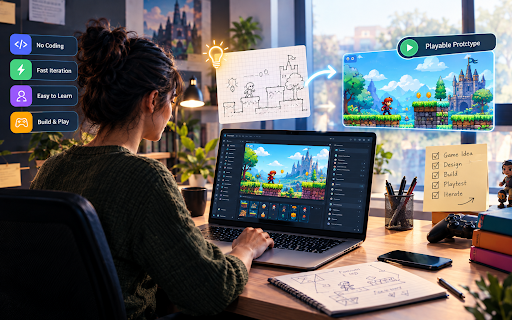
Prototyping has always been the stage where game ideas either prove themselves or reveal fundamental problems, but the time and technical overhead required to reach that stage used to filter out most people before they got there. You needed either significant programming skill or the resources to hire someone who had it, and by that point, the momentum behind an idea had often already faded. No-code tools have changed that completely, not by making prototyping magical or effortless, but by removing the specific technical barriers that used to stand between an idea and a testable version of it.
What Traditional Prototyping Actually Required
The Hidden Time Cost of Manual Implementation
Building a playable prototype manually meant translating a concept into working code before you could evaluate whether that concept was actually any good. That translation step took weeks at minimum, regardless of how simple the underlying idea was. A mechanic that could be described in a sentence might require days of programming to produce something testable, and only then could you find out whether it was actually fun or a dead end.
The Skill Requirement That Filtered Out Most Ideas
The programming knowledge needed to prototype wasn’t optional, it was essential. This created a hard filtering effect where genuinely good design concepts got stuck in people’s heads because the technical barrier to testing them was too high, while people with solid programming skill but mediocre design intuition could at least build something and see how it played.
The Psychological Weight of Commitment
When prototyping required serious time investment upfront, there was psychological pressure to commit to a direction and see it through rather than abandoning it based on early testing results. That pressure to ride out a flawed concept was baked into the process itself, making it rare for a developer to walk away from an idea that wasn’t working and try something completely different instead.
How No-Code Tools Simplify the Translation
From Code to Plain Language Description
The single biggest simplification is replacing technical implementation with natural-language description. You explain what you want the player to do, what the goal is, and what happens on success or failure. Game maker online platforms handle translating that description into a working prototype, removing the weeks of manual coding that used to stand in the way.
Removing the Skill Requirement Entirely
Because description replaces coding, the technical barrier to prototyping disappears. Someone without any programming background can now generate a working, playable prototype of their idea within the same session they conceive it, which fundamentally changes what becomes possible.
Compressing Idea-to-Playable Timeline
What used to take weeks now takes hours. That compression matters far more than just speed for speed’s sake, it changes how creators approach design itself. When you can test an idea within a few hours, experimental thinking becomes practical rather than impossible, and the psychological weight of committing to a specific direction before testing it vanishes.
What Gets Simplified During the Prototyping Process
Asset Production Is No Longer a Bottleneck
Traditionally, creating even placeholder assets consumed significant time, creating a chicken-and-egg problem: you couldn’t test a game’s feel without visual and audio elements, but producing those elements before confirming the core concept was sound seemed wasteful. No-code platforms generate usable or placeholder assets automatically, removing that bottleneck entirely.
Iteration Happens in the Same Medium as Prototyping
When prototyping happened through coding, iteration meant going back to edit code, rebuild, and retest. With no-code tools, iteration stays in the same descriptive medium, describe an adjustment, test the new version, notice the difference. Staying in the same conceptual space removes friction from the refinement process.
Testing Doesn’t Require Export or Build Steps
A traditional prototype often needed to be built, exported, or deployed before it could be tested. No-code platforms eliminate that step entirely, you generate a version and play it immediately. That instant access to playable results keeps the feedback loop tight and momentum high.
Sharing for Early Feedback Becomes Trivial
Generating a shareable link to a rough prototype takes seconds. Getting outside reactions to your work early, when changes are still cheap, becomes realistic instead of something reserved for after significant investment. Games like Fake or Break demonstrate what focused, well-tested core mechanics look like, the kind of polish that often comes from early outside feedback applied repeatedly rather than internal iteration alone.
How Simplified Prototyping Changes Development Approach
Validation Happens Before Commitment
Because generating a rough prototype is now trivially fast, confirming whether a core mechanic is actually fun happens before significant resources get committed to surrounding content, polish, or infrastructure. That early validation prevents the expensive mistake of building extensively around a flawed foundation.
Comparison Becomes the Default Rather Than the Exception
When prototyping was expensive, committing to one direction and refining it made sense. When prototyping is cheap, testing multiple approaches to the same problem before committing becomes practical. That comparison tends to produce noticeably stronger final concepts than settling on the first workable idea.
Multiple Directions Can Be Explored Simultaneously
A creator or small team can prototype several concepts in parallel, test them against each other, and pursue the most promising one rather than having to choose a direction and commit fully before seeing how alternatives might play out.
Failure Becomes Information Rather Than Wasted Time
A prototype that reveals a flawed concept isn’t wasted time anymore, it’s productive failure that ruled out a dead end and freed resources for more promising directions. That shift in mindset, from treating failure as loss to treating it as useful information, is part of what simplified prototyping actually enables.
What No-Code Prototyping Still Requires
Clear Enough Thinking to Describe the Idea
The platform translates description into mechanics, but it doesn’t generate the underlying concept. Knowing what you want to build and being able to describe it clearly remains entirely your responsibility, no tool replaces that.
Honest Evaluation of the Result
A simplified prototyping process makes it easy to generate versions quickly. It doesn’t make the judgment about whether a version is actually good any easier. That evaluation still requires honest playtesting, watching how real people interact with your work, and willingness to recognize when something isn’t working.
Discipline to Not Keep Adding Features
Because generating new versions costs relatively little, the temptation to keep expanding and adding during the prototype phase grows. Staying focused on validating the core mechanic before layering in additional complexity requires deliberate restraint.
Common Misconceptions About Simplified Prototyping
“Faster Prototyping Means Lower Quality”
This assumes speed and quality are in conflict, which they’re not. Faster iteration, used well, tends to produce better final results because more testing and comparison becomes realistic within the same overall timeline.
“Simplified Tools Produce Simplified Results”
No-code platforms simplify the process, not the outcomes. Games built this way can be just as polished, engaging, and original as anything built manually, the tools just remove unnecessary friction from getting there.
“Real Prototyping Still Requires Code”
For many kinds of projects, validating a core concept doesn’t require coding at all. Specialized edge cases exist where custom implementation matters from the start, but for the vast majority of game prototypes, testing and validation is entirely achievable without touching code.
The Practical Effect on Creative Work
More Ideas Get Tested
Creators who can prototype quickly end up testing far more ideas than those using slower methods, which means more opportunities to discover something genuinely original rather than refining variations on a familiar theme.
Better Design Instincts Develop Faster
Rapid feedback creates faster learning. A creator who prototypes twenty concepts in a year develops stronger design intuition than one who carefully develops two, simply through sheer exposure to what works and what doesn’t.
Beginners Can Compete on Conceptual Merit
Someone new to game design but with strong creative instincts can now build something genuinely worth playing without needing years of technical training first. That access matters enormously for diversity in who gets to participate in game creation.
Final Thoughts
No-code tools simplify game prototyping by removing the technical barriers that used to stand between an idea and a testable version of it, but simplification isn’t the same as elimination. Good prototypes still require clear thinking, honest evaluation, and disciplined decision-making about what to test and what to discard.
What’s genuinely changed is that these creative skills no longer need to be paired with specialized technical ability to produce results. Someone with strong design instincts can now act on those instincts immediately, test them in real play, and learn from what works and what doesn’t, without years of programming study standing in the way first. That shift is fundamentally changing who participates in game creation and what becomes possible when the friction is finally gone.