Mirepoix: The Simple French Base Behind Better Soups, Stocks and Sauces
Three basic vegetables can change the whole pot. Here’s what mirepoix is, how the classic 2:1:1 ratio works, when to brown it, and where cooks use it.

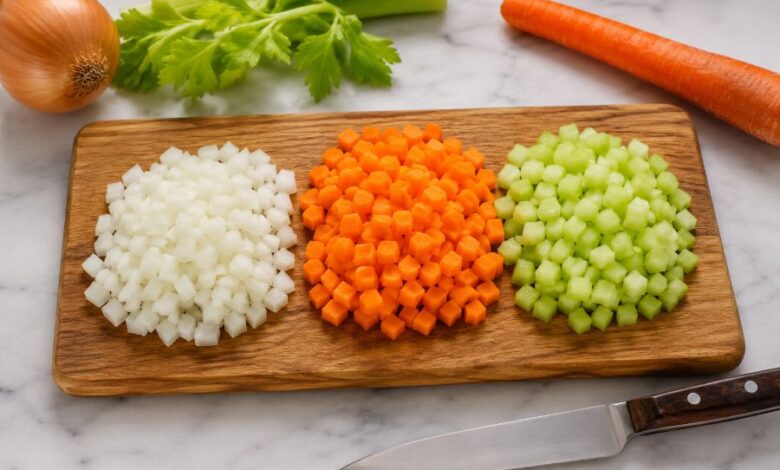
The classic 2:1:1 mix of onion, carrot and celery explained simply.
A pot of soup can have good stock, fresh vegetables and the right seasoning, yet still taste a little flat.
Sometimes the missing part starts much earlier.
It starts with mirepoix.
Mirepoix is the classic French mix of onion, carrot and celery used as a flavour base for stocks, soups, sauces, stews and braised dishes. The vegetables may look ordinary. Their job isn’t.
Cook them gently and they release sweetness, aroma and savoury vegetable flavour into the fat and liquid around them. That flavour then runs through the rest of the dish.
The standard formula is easy:
2 parts onion + 1 part carrot + 1 part celery.
That is the version most cooks mean today when they say “mirepoix.” The Culinary Institute of America uses the same 2:1:1 formula and gives an example of 8 ounces onion, 4 ounces carrot and 4 ounces celery for one pound of mirepoix.
But there is more behind this French cooking term.
Its history is surprisingly rich. The vegetables do not always need the same size. Browning can be right or wrong depending on the dish. White mirepoix has a different mix. And the early French versions were far more complicated than three chopped vegetables.
Let us break it down.
Quick Facts About Mirepoix
| Fact | Detail |
|---|---|
| What is mirepoix? | A French aromatic vegetable base |
| Main ingredients | Onion, carrot and celery |
| Classic ratio | 2:1:1 |
| Ratio breakdown | 50% onion, 25% carrot, 25% celery |
| Pronunciation | Meer-PWAH |
| Main purpose | Build background flavour |
| Common uses | Stocks, soups, sauces, stews and braises |
| Usual cooking style | Gentle cooking in butter or oil |
| Must it be browned? | No; it depends on the dish |
| Can you eat it? | Yes, though it is often strained from stocks |
| White mirepoix | Onion, celery/celeriac, parsnip and leek |
| French origin | Yes |
| Can it be frozen? | Yes |
| Is garlic required? | No |
| Vegan? | Yes, if cooked without animal fat |
What Is Mirepoix?
Mirepoix is a mixture of aromatic vegetables used near the beginning of cooking.
The standard version contains:
- onion
- carrot
- celery
Simple stuff.
But each vegetable brings something different.
Onion gives sweetness and a savoury smell once cooked.
Carrot adds mild sweetness and earthy flavour.
Celery brings a greener, herbal note.
Together, they make food taste fuller without making the finished dish taste strongly of one vegetable.
Cambridge Dictionary defines mirepoix as a mixture, usually including onions, carrots and celery, chopped and gently cooked as a base for soups and sauces.
That last part matters.
Mirepoix is usually a base, not the star of the plate.
You may barely notice it.
Yet take it away and the difference can be obvious.
How Do You Pronounce Mirepoix?
The easiest English approximation is:
meer-PWAH
The last x is silent.
Cambridge gives the UK pronunciation as /ˌmɪəˈpwɑː/ and the US pronunciation as /ˌmɪr.əˈpwɑː/.
So no, it is not “mire-pox.”
The French spelling looks harder than the actual word sounds.
What Is the Classic Mirepoix Ratio?
The common professional ratio is:
2:1:1
That means:
- 2 parts onion
- 1 part carrot
- 1 part celery
By percentage, that comes to:
- 50% onion
- 25% carrot
- 25% celery
For example:
- 200g onion
- 100g carrot
- 100g celery
Or, using the CIA example:
- 8 oz onion
- 4 oz carrot
- 4 oz celery
That gives one pound of mirepoix.
Is the 2:1:1 ratio by weight or volume?
Using weight gives better consistency.
A cup of chopped onion does not weigh the same as a cup of carrot or celery. Vegetable shape, water content and chopping size all change volume.
At home, though, you do not need kitchen-lab precision.
Roughly twice as much onion as carrot or celery works well.
Cooking should still feel like cooking.
Why Does Mirepoix Use More Onion?
Onion makes up the largest share because it gives a broad sweet-savoury base without becoming too sharp after slow cooking.
Too much carrot can push the mixture toward sweetness.
Too much celery can give it a stronger green or slightly bitter edge.
The standard ratio keeps those flavours in check.
But it is still a cooking formula.
Not a law.
If your soup needs more carrot, use more carrot.
If you dislike celery, adjust it.
Just know that you are moving away from the classic ratio.
What Does Mirepoix Taste Like?
Properly cooked mirepoix should not scream, “I contain celery.”
The flavours soften together.
You get:
- gentle sweetness
- savoury depth
- mild earthiness
- vegetable aroma
- a soft herbal note
Basically, it makes the next ingredients taste more complete.
That is why it works so well under chicken stock, beef stew, lentil soup, gravy and slow-cooked meat.
What Is Mirepoix Used For?
Mirepoix shows up in many parts of French and Western cooking.
The CIA lists it as a common base for stocks, soups, sauces, stews and braises.
Stocks
This is one of its best-known jobs.
Mirepoix can flavour:
- chicken stock
- beef stock
- veal stock
- vegetable stock
- brown stock
The vegetables may simply simmer with the stock ingredients.
They do not always need frying first.
Soups
Think of:
- chicken soup
- vegetable soup
- lentil soup
- bean soup
- beef soup
- creamy vegetable soups
In rustic soup, the mirepoix may stay in the bowl.
In a refined soup, it may be blended or strained.
Stews
Beef stew often starts this way.
So can lamb or chicken stew.
The vegetables soften while the meat cooks and become part of the sauce.
Sauces
Mirepoix can sit behind:
- brown sauces
- tomato sauces
- gravy
- pan sauces
- meat sauces
Here the cut often gets smaller because the cooking time may be shorter.
Braised Meat
Pot roast is a classic example.
Large pieces of onion, carrot and celery cook around the meat, releasing flavour into the braising liquid for hours.
Should Mirepoix Be Fried or Sweated?
Usually, classic mirepoix is cooked gently.
The common technique is called sweating.
The vegetables sit over fairly low heat with enough fat to coat them.
They soften.
Moisture comes out.
The smell changes.
But they do not develop a dark crust.
Escoffier School describes French mirepoix as onion, carrot and celery cooked slowly over low heat, traditionally without browning, especially when a softer background flavour is wanted.
What does sweating mean?
Sweating is not the same as hard frying.
You are trying to soften the vegetables.
Not burn them.
The onions may become slightly translucent.
The carrot begins to soften.
The celery loses some raw sharpness.
That is enough for many dishes.
Can You Brown Mirepoix?
Yes.
This causes a lot of confusion.
Some explanations say mirepoix should never brown.
That is too strict.
For light stocks, cream soups and delicate sauces, heavy colour is usually unwanted.
But brown stocks and rich braises are different.
The CIA notes that mirepoix may be sweated, smothered, roasted or browned, with browning giving richer savoury-sweet flavours.
So use the dish as your guide.
Keep it pale for:
- white stock
- light chicken stock
- cream soup
- pale sauce
- delicate poultry dishes
Let it colour more for:
- brown beef stock
- veal stock
- dark gravy
- pot roast
- beef stew
- rich braised dishes
Same vegetables.
Different result.
What Fat Should You Use?
Butter fits classical French cooking well.
But it is not your only choice.
You can use:
- butter
- olive oil
- neutral cooking oil
- chicken fat
- rendered meat fat
Pick the fat that fits the dish.
For a vegetable soup, olive oil works.
For a classic French sauce, butter makes sense.
For a rich meat braise, rendered fat can work very well.
Does Mirepoix Need Garlic?
No.
Garlic is not part of the standard onion-carrot-celery formula.
You can still add it.
Many cooks do.
But once garlic, leek, shallot, tomato, herbs or peppers enter the pan, you are building on the classic mirepoix rather than following the basic three-vegetable version.
That is perfectly fine.
Food changes by recipe.
How Big Should You Cut Mirepoix?
There is no single correct mirepoix dice.
This is a useful detail.
A lot of recipes simply say “dice the vegetables,” which makes people think they need perfect little cubes.
They usually do not.
The CIA recommends matching the vegetable size to the cooking time: smaller or thinner pieces for short cooking and larger pieces for long cooking.
Short cooking time
Cut smaller pieces.
Good for:
- quick sauces
- pan gravy
- short-cooked soups
Medium cooking time
Use a normal dice.
Good for:
- everyday soup
- stew
- beans
- lentils
Long cooking time
Use larger pieces.
Good for:
- pot roast
- brown stock
- long braises
Think about why.
A tiny carrot cube releases flavour quickly.
Leave it in a stockpot for many hours and it may break down badly.
A bigger chunk holds up longer.
Pretty simple.
Does Mirepoix Need Perfect Knife Cuts?
No.
Especially not for stock.
If the vegetables will be strained out later, perfectly square restaurant-style dice do little for the finished plate.
Try to keep the pieces reasonably similar.
That helps them cook at a similar speed.
If the vegetables stay in the soup, neat cutting matters more because you will actually see and eat them.
Basic Mirepoix Recipe
Here is an easy home version.
Ingredients
- 200g onion
- 100g carrot
- 100g celery
- butter or cooking oil, as needed
Method
Peel or trim the vegetables as needed.
Cut them to suit the cooking time.
Warm a little fat in the pan.
Add the onion.
Let it begin softening.
Add the carrot and celery.
Keep the heat gentle for a pale mirepoix.
Cook until the vegetables soften and smell sweet.
Then continue with your soup, stock, stew or sauce.
For a darker dish, let the vegetables gain more colour before adding the next ingredients.
That is it.
No fancy trick.
Can Mirepoix Go Straight Into Stock?
Yes.
You do not always need to cook it separately.
Cut vegetables can go straight into simmering stock.
They still release flavour.
Cooking them in fat first simply changes that flavour.
The CIA notes that raw mirepoix added directly to a simmering pot still gives aroma, while sweating, roasting or browning creates different flavour results.
So both methods are valid.
What Is White Mirepoix?
White mirepoix is used when cooks want aromatic flavour without the orange colour from carrots.
The CIA version uses equal parts:
- onion
- celery or celeriac
- parsnip
- leek
It works well in:
- white stocks
- cream soups
- pale sauces
- light poultry preparations
Carrot is usually left out because its colour can tint the liquid.
That is the main idea.
What Is Mirepoix au Gras?
Older French cooking had several forms of mirepoix.
Mirepoix au gras includes animal ingredients such as ham, bacon or another fatty meat element alongside the aromatics.
This sounds strange if you only know today’s supermarket packs of chopped onion, carrot and celery.
Historically, though, mirepoix was much broader.
Merriam-Webster still defines the word broadly enough to mention herbs and sometimes ham or bacon.
Mirepoix Was Not Always Just Three Vegetables
This part gets missed a lot.
The early French meaning was richer than the modern formula.
Antoine Beauvilliers’ 1814 L’Art du Cuisinier includes Sauce à la Mirepoix. It points back to a preparation containing veal, ham, bacon, carrots, onions, herbs, lemon, butter and stock. Wine was used in the Mirepoix sauce version.
That is far removed from a bag of chopped vegetables.
Later French cooking moved toward the aromatic vegetable base people recognise today.
Auguste Escoffier’s classical work still included versions using vegetables, herbs and ham.
So the current 2:1:1 mix is best treated as the standard modern form, not the only form the word has ever had.
Where Did the Name Mirepoix Come From?
The name is linked to the French duc de Mirepoix.
Merriam-Webster says the word probably comes from Charles de Lévis, duc de Mirepoix, who died in 1757, or from one of his successors. The dictionary dates its first known English use to 1877.
You may also see a popular story saying the duke’s chef invented the mixture and named it after him.
Maybe.
But that story should not be presented as proven fact.
The safer historical point is simple:
The culinary term became associated with the Mirepoix name, while the exact story behind that naming is less certain.
Mirepoix vs Soffritto
They can look almost identical.
French mirepoix commonly uses:
- onion
- carrot
- celery
Italian soffritto often uses the same vegetables.
So what changes?
Technique and local cooking habits.
Soffritto is commonly cooked in olive oil and usually stays in the finished dish. Other ingredients can enter the mix depending on the recipe.
French mirepoix is strongly linked with butter, stocks, sauces and braises, and may later be strained.
Escoffier School lists both as related aromatic bases but treats them as separate culinary traditions.
Mirepoix vs the Cajun Holy Trinity
This comparison is easy to remember.
Mirepoix
- onion
- carrot
- celery
Cajun and Creole Holy Trinity
- onion
- celery
- bell pepper
The bell pepper replaces carrot.
The CIA gives a common Holy Trinity ratio of two parts onion, one part celery and one part bell pepper.
It appears in dishes such as:
- gumbo
- jambalaya
- étouffée
They share the same basic idea.
Start with aromatic vegetables.
Build flavour from there.
Mirepoix vs Sofrito
These names sound similar.
The mixes are not always similar.
Spanish-style sofrito commonly leans on ingredients such as:
- onion
- garlic
- tomato
- olive oil
Regional versions can use peppers and other ingredients too.
Mirepoix is usually less tomato-heavy and more closely tied to onion, carrot and celery.
Do not treat the two names as direct translations.
Mirepoix vs Bouquet Garni
Another easy mix-up.
Mirepoix is mostly vegetables.
Bouquet garni is based around herbs.
A common bouquet garni may include:
- thyme
- bay leaf
- parsley
Both can go into the same stockpot.
They simply do different jobs.
Mirepoix vs Matignon
Matignon is another French aromatic preparation closely related to mirepoix.
Escoffier described matignon using finely cut carrot, onion and celery with lean ham, thyme and bay, cooked in butter and finished with Madeira. He then described mirepoix as having a similar purpose but a different mode of use.
In practical terms, matignon is often treated as a finer aromatic mixture that stays with the food, while stock mirepoix may be strained away.
It is a classical distinction.
Most home cooks do not need to worry about it every day.
What Is Pinçage?
Pinçage sometimes appears near discussions of brown mirepoix and brown sauces.
It is not simply another name for mirepoix.
The term is associated with cooking tomato paste until it darkens and develops a deeper roasted taste.
It may be done after browning aromatic vegetables for a dark stock or sauce.
So:
mirepoix = aromatic vegetables
pinçage = browning tomato paste
Different jobs.
Can You Substitute Ingredients in Mirepoix?
Yes.
The classic version is useful because it gives a known flavour balance.
But kitchens deal with real cupboards.
Maybe you have no celery.
Maybe someone dislikes carrot.
Maybe the dish needs something different.
Possible celery substitutes
Try:
- celeriac
- leek
- fennel
Celeriac keeps some celery character.
Leek is softer and sweeter.
Fennel changes the flavour more noticeably.
Possible carrot substitutes
Try:
- parsnip
- extra onion
- leek
- celeriac
Parsnip works especially well in pale preparations.
No onion?
Leek or shallot may work.
The result will taste different.
Still useful.
Is Mirepoix Vegetarian or Vegan?
The vegetables are plant-based.
So a basic mirepoix cooked in vegetable oil is vegan.
A butter version is vegetarian but not vegan.
Historical or meat-based versions may contain:
- bacon
- ham
- animal fat
- meat stock
Check the complete recipe.
The word alone does not guarantee that a finished dish is vegan.
Is Mirepoix Gluten-Free?
Plain onion, carrot and celery do not contain gluten.
A simple mirepoix cooked in plain oil or butter is generally gluten-free.
Problems can appear later.
Stock cubes, sauces, seasoning mixes and packaged foods may contain other ingredients.
If you need strict gluten avoidance, check the full ingredient list.
Is Mirepoix Healthy?
Mirepoix is mostly vegetables.
That gives you onion, carrot and celery without needing a heavy ingredient list.
But “mirepoix” is a cooking technique, not a fixed nutrition product.
Calories and fat depend heavily on:
- portion size
- cooking fat
- meat additions
- sauce
- stock
- the finished recipe
A spoonful of vegetables cooked in a little oil is one thing.
A meat-rich sauce made with butter and bacon is another.
Context matters.
Can You Buy Mirepoix Already Chopped?
Yes.
Many supermarkets sell fresh or frozen chopped mirepoix.
That can save prep time.
Check the pack.
Some mixes keep the classic onion-carrot-celery combination, while others change the proportions or add another vegetable.
Pre-cut mirepoix works especially well for:
- weekday soup
- stew
- slow cooker meals
- stock
- meal prep
Freshly cut vegetables give you more control over size.
Pre-cut wins on speed.
Pick what matters that day.
Can You Freeze Mirepoix?
Yes.
Freezing works particularly well if the vegetables will later go into soup, stock, stew or sauce.
Texture may soften.
That does not matter much in a long-cooked dish.
Portion the chopped vegetables before freezing so you can grab what you need without thawing a large block.
Keep the freezer at 0°F (-18°C) or below. USDA food-safety guidance uses that temperature for frozen food storage and recommends 40°F (4°C) or below for refrigerators.
How Should You Store Fresh Mirepoix?
If you chop it ahead, keep it refrigerated in a covered container.
Keep the refrigerator at 40°F/4°C or colder.
For best eating quality, prep only as much as you expect to use soon.
If plans change, freeze it.
That saves waste.
Common Mirepoix Mistakes
1. Using high heat for a pale dish
The vegetables brown before they soften properly.
Use gentler heat.
2. Cutting huge pieces for a quick sauce
Large chunks need time.
Cut smaller for short cooking.
3. Cutting tiny pieces for a long stock
They may fall apart long before the stock is done.
Go larger.
4. Using too much carrot
The base can become noticeably sweet.
5. Using too much celery
The flavour can become sharper and greener.
6. Burning added garlic
Garlic cooks faster than thick carrot or onion.
Add it later when needed.
7. Treating 2:1:1 like a strict law
It is a standard starting point.
Recipes still need judgement.
8. Spending ages on perfect dice
For stock that gets strained, neat enough is enough.
Save the perfect knife work for vegetables people will see.
Why Does Mirepoix Work So Well?
Because flavour starts before the liquid goes in.
That is the real point.
Raw onion, carrot and celery can taste quite separate.
Heat changes them.
The onion softens.
The carrot gets sweeter.
The celery loses some raw bite.
Fat picks up aromatic compounds and spreads them through the food.
Then stock, tomato, meat, beans, wine or water enters the pan.
Now they have something to build on.
A simple start.
A big difference.
Do You Remove Mirepoix Before Serving?
Sometimes.
For clear stock, you usually strain the vegetables out.
Their job is finished.
For stew or rustic soup, they may stay.
For sauce, they might be strained, blended or cooked until they almost disappear.
There is no single rule.
Think about the texture you want at the end.
Can You Reuse Mirepoix After Making Stock?
You technically can eat the vegetables.
But after a long stock simmer, much of their flavour has moved into the liquid.
That was the whole job.
They may taste soft, weak and washed out.
Most cooks discard or compost them after straining the stock.
Using fresh vegetables in the next dish gives a much better result.
Does Mirepoix Need Salt?
Not always.
For a soup that will be served soon, a little salt during cooking may make sense.
For stock, many cooks hold back.
Stock may later be reduced into gravy or sauce.
Reduction concentrates salt.
Starting lightly gives you more control later.
Is Mirepoix Only French?
The name is French.
The idea is not.
Cooks around the world start dishes with aromatic vegetables, herbs or spices.
French cooks have mirepoix.
Italian cooking has soffritto.
Cajun and Creole cooking uses the Holy Trinity.
Spanish cooking has sofrito.
Other cuisines have their own starting combinations.
The ingredients change.
The logic stays familiar: cook strong aromatic ingredients early so their flavour runs through the food.
Does Mirepoix Mean Something Else?
Yes.
Mirepoix is also the name of a place in southern France.
The culinary word is linked historically with the French Mirepoix name and the duc de Mirepoix.
So a search for “Mirepoix France” may take you to the town rather than a chopping board.
Same name.
Different subject.
Final Thought
Mirepoix looks almost too basic to matter.
An onion. A carrot. Some celery.
But cooking often works that way.
Small choices early in the pan change everything that follows.
Remember the 2:1:1 ratio. Match the cut to the cooking time. Keep it pale when you want a light flavour, or give it colour when the dish needs something deeper.
Then let it do its job quietly.
That is what good mirepoix does.
Frequently Asked Questions
What are the three main ingredients?
The classic mix uses onion, carrot and celery.
What is the standard ratio?
A common ratio is 2 parts onion, 1 part carrot and 1 part celery.
How do you pronounce it?
Say meer-PWAH. The final “x” stays silent.
Is garlic included?
Not in the classic version. You can add garlic, but it is optional.
Should the vegetables be sautéed?
Usually, they are cooked gently in fat. Keep them pale for lighter dishes, or let them brown slightly for richer stocks and braises.
Can I make it without celery?
Yes. Celeriac or leek can work as substitutes, though the flavour will change.
Is it the same as soffritto?
No. The ingredients can be similar, but the cooking style, fat and regional use may differ.
What is the Cajun alternative?
The Cajun and Creole Holy Trinity uses onion, celery and bell pepper.
Can the chopped vegetables be frozen?
Yes. The mix freezes well for soups, stocks, stews and sauces.
Are the vegetables eaten after cooking?
Sometimes. They often stay in soups and stews, but may be strained out of stocks and smooth sauces.
What is the white version?
White mirepoix usually leaves out carrot and may use onion, celery or celeriac, parsnip and leek.
Where does the name come from?
The term is linked to Charles de Lévis, duc de Mirepoix, or one of his successors. The exact origin story is not fully documented.