KMH to MPH: Formula, Conversion Chart and Easy Calculator Method
Convert kilometres per hour to miles per hour accurately, learn the simple formula, check common driving speeds, and see why 100 km/h equals about 62.14 mph.

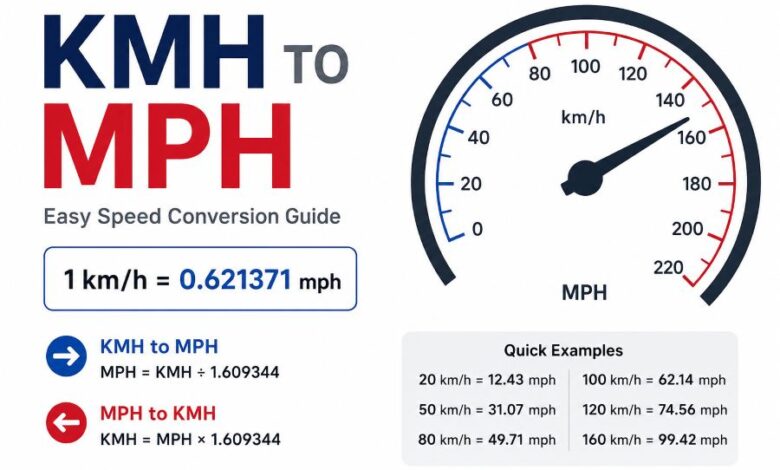
Searching for KMH to MPH usually means one thing. You need a number. Fast.
Here it is.
1 km/h = 0.621371 mph
That single conversion factor handles pretty much every calculation.
For example, 80 km/h becomes 49.71 mph. A speed of 100 km/h becomes 62.14 mph. Push it to 160 km/h and you get about 99.42 mph.
Simple enough.
There is still a bit more behind those numbers, especially if you need accurate calculations for driving, vehicle specifications, cycling, running, engineering work, or travel.
Quick Fact: 1 km/h equals approximately 0.621371 mph. To convert KMH to MPH, multiply the speed by 0.621371, or divide it by 1.609344. So, 100 km/h = 62.14 mph.
| Quick Fact | Details |
|---|---|
| 1 km/h in mph | 0.621371 mph |
| 1 mph in km/h | 1.609344 km/h |
| 100 km/h in mph | 62.14 mph |
| 80 km/h in mph | 49.71 mph |
| 120 km/h in mph | 74.56 mph |
| 160 km/h in mph | 99.42 mph |
| KMH to MPH Formula | km/h × 0.621371 |
| Alternative Formula | km/h ÷ 1.609344 |
| MPH to KMH Formula | mph × 1.609344 |
| Best Quick Estimate | km/h × 0.62 |
KMH to MPH Formula
The standard formula is:
MPH = KM/H × 0.6213711922
You can also calculate it this way:
MPH = KM/H ÷ 1.609344
Both methods give the same answer.
Take 100 km/h.
100 × 0.6213711922 = 62.13711922 mph
Rounded to two decimal places:
100 km/h = 62.14 mph
The number 1.609344 comes from the international mile.
According to NIST measurements:
1 international mile = 1.609344 kilometres exactly
That fixed relationship gives us the KMH to MPH conversion factor.
Quick KMH to MPH Conversion Chart
Need the answer quickly?
Use this table.
| KM/H | MPH |
|---|---|
| 1 km/h | 0.62 mph |
| 5 km/h | 3.11 mph |
| 10 km/h | 6.21 mph |
| 15 km/h | 9.32 mph |
| 20 km/h | 12.43 mph |
| 25 km/h | 15.53 mph |
| 30 km/h | 18.64 mph |
| 35 km/h | 21.75 mph |
| 40 km/h | 24.85 mph |
| 45 km/h | 27.96 mph |
| 50 km/h | 31.07 mph |
| 55 km/h | 34.18 mph |
| 60 km/h | 37.28 mph |
| 65 km/h | 40.39 mph |
| 70 km/h | 43.50 mph |
| 75 km/h | 46.60 mph |
| 80 km/h | 49.71 mph |
| 90 km/h | 55.92 mph |
| 100 km/h | 62.14 mph |
| 110 km/h | 68.35 mph |
| 120 km/h | 74.56 mph |
| 130 km/h | 80.78 mph |
| 140 km/h | 86.99 mph |
| 150 km/h | 93.21 mph |
| 160 km/h | 99.42 mph |
| 180 km/h | 111.85 mph |
| 200 km/h | 124.27 mph |
| 250 km/h | 155.34 mph |
| 300 km/h | 186.41 mph |
Common KMH to MPH Conversions
Some speeds appear far more often.
Drivers see them. Cyclists see them. Car buyers see them too.
Here are the common ones.
20 KMH to MPH
20 km/h = 12.43 mph
Calculation:
20 × 0.621371 = 12.42742 mph
Rounded:
12.43 mph
30 KMH to MPH
30 km/h = 18.64 mph
This is close to 20 mph, but not exactly.
40 KMH to MPH
40 km/h = 24.85 mph
For quick mental maths, call it roughly 25 mph.
50 KMH to MPH
50 km/h = 31.07 mph
That makes 50 km/h slightly faster than 30 mph.
60 KMH to MPH
60 km/h = 37.28 mph
A rough estimate would be 37 mph.
80 KMH to MPH
80 km/h = 49.71 mph
This one is easy to remember.
80 km/h is almost 50 mph.
100 KMH to MPH
100 km/h = 62.14 mph
This is probably the best-known conversion.
It also shows why saying “100 km/h is 60 mph” is only a rough estimate.
The actual figure is more than two mph higher.
120 KMH to MPH
120 km/h = 74.56 mph
Rounded to the nearest whole number:
75 mph
130 KMH to MPH
130 km/h = 80.78 mph
That is roughly 81 mph.
160 KMH to MPH
160 km/h = 99.42 mph
Interesting one.
160 km/h is very close to 100 mph, but it falls slightly short.
Exactly 100 mph equals:
160.9344 km/h
200 KMH to MPH
200 km/h = 124.27 mph
This speed comes up often in performance-car specifications and motorsport figures.
What Does KM/H Mean?
KM/H means kilometres per hour.
The proper unit symbol is:
km/h
It measures speed by showing how many kilometres would be travelled during one hour at a constant rate.
Think about 60 km/h.
If that speed stayed unchanged for one full hour, the distance travelled would be 60 kilometres.
One kilometre contains:
1,000 metres
The metre is the SI base unit of length.
The formal coherent SI unit for speed is actually metres per second, written as m/s. Still, km/h is accepted for use with SI and is widely used for road and vehicle speeds.
Is KMH the Same as KPH?
Basically, yes.
People write this unit several ways:
- km/h
- kmh
- KMH
- kph
- KPH
- kmph
They normally refer to kilometres per hour.
For formal writing, km/h is the standard symbol.
For search queries, people often type kmh to mph, kph to mph, or kmph to mph.
The calculation stays the same.
What Does MPH Mean?
MPH means miles per hour.
It tells you how many miles would be travelled in one hour if the speed stayed constant.
For example:
60 mph
means a vehicle travelling at that steady speed would cover 60 miles in one hour.
One international mile equals:
1,609.344 metres
or:
1.609344 kilometres
That value is exact.
NIST technical tables may write miles per hour as mi/h, while mph is the everyday form most people recognise.
Why Does 1 KMH Equal 0.621371 MPH?
Here is how the maths works.
One international mile contains:
1.609344 kilometres
So one kilometre contains:
1 ÷ 1.609344 miles
Calculate that and you get:
0.621371192237… miles
Both speed units use the same time period.
One hour.
Only the distance unit changes.
So:
1 km/h = 0.621371192237… mph
That is where the familiar 0.621371 figure comes from.
Easy Way to Convert KMH to MPH
Nobody wants to pull out a scientific calculator while travelling.
There are some easier tricks.
Multiply by 0.62
For everyday estimates:
KMH × 0.62 ≈ MPH
Example:
100 × 0.62 = 62
So:
100 km/h ≈ 62 mph
The accurate answer is 62.14 mph.
Pretty close.
Divide by 1.6
Another quick method:
KMH ÷ 1.6
Take 80 km/h.
80 ÷ 1.6 = 50
The accurate result is:
49.71 mph
Again, close enough for casual comparison.
Multiply by Five, Then Divide by Eight
Here is another mental trick.
Multiply the KMH number by five, then divide by eight.
For 80 km/h:
80 × 5 = 400
400 ÷ 8 = 50
Estimated answer:
50 mph
Actual answer:
49.71 mph
It works because 5/8 equals 0.625, which sits quite close to the real factor of 0.621371.
Which Conversion Method Should You Use?
Depends what you need.
For a quick estimate:
multiply by 0.62
For casual mental maths:
divide by 1.6
For accurate calculations:
multiply by 0.6213711922
For maximum mathematical accuracy:
divide by 1.609344
Small differences rarely matter in conversation.
Technical work is different.
Use the proper factor there.
MPH to KMH Conversion
Sometimes you need to go backwards.
The formula changes.
KM/H = MPH × 1.609344
For example:
60 mph × 1.609344
= 96.56064 km/h
So:
60 mph = 96.56 km/h
Here are several common values.
| MPH | KM/H |
|---|---|
| 10 mph | 16.09 km/h |
| 20 mph | 32.19 km/h |
| 30 mph | 48.28 km/h |
| 40 mph | 64.37 km/h |
| 50 mph | 80.47 km/h |
| 60 mph | 96.56 km/h |
| 70 mph | 112.65 km/h |
| 80 mph | 128.75 km/h |
| 90 mph | 144.84 km/h |
| 100 mph | 160.93 km/h |
| 120 mph | 193.12 km/h |
| 150 mph | 241.40 km/h |
KMH to Metres Per Second
There is another useful conversion.
To change km/h into metres per second:
m/s = km/h ÷ 3.6
Example:
36 km/h ÷ 3.6 = 10 m/s
So:
36 km/h = 10 m/s
A few more:
| KM/H | M/S |
|---|---|
| 18 km/h | 5 m/s |
| 36 km/h | 10 m/s |
| 54 km/h | 15 m/s |
| 72 km/h | 20 m/s |
| 90 km/h | 25 m/s |
| 108 km/h | 30 m/s |
One km/h equals approximately:
0.277778 m/s
MPH to Metres Per Second
For MPH:
m/s = mph × 0.44704
The factor 0.44704 is exact when converting an international mile per hour into metres per second.
Examples:
10 mph = 4.4704 m/s
50 mph = 22.352 m/s
60 mph = 26.8224 m/s
100 mph = 44.704 m/s
KMH vs MPH: What Is the Difference?
They measure the same thing.
Speed.
The distance unit changes.
KM/H uses kilometres.
MPH uses miles.
Since a mile is longer than a kilometre, the MPH number will be smaller than the KM/H number for the same physical speed.
Think about this:
100 km/h = 62.14 mph
Same speed.
Different number.
That point catches people out.
KMH to MPH for Driving
This conversion becomes especially useful while travelling.
The United Kingdom uses miles per hour on road speed-limit signs.
Ireland uses kilometres per hour.
That creates an obvious situation.
A driver crossing between measurement systems may need to read one unit while mentally thinking in another.
Imported vehicles can cause the same issue.
A dashboard may show:
km/h only
mph only
or:
both units
Many digital dashboards also allow the driver to switch between them.
Common Road-Speed Comparisons
These values are handy to remember:
| KM/H | Approximate MPH |
|---|---|
| 30 km/h | 19 mph |
| 40 km/h | 25 mph |
| 50 km/h | 31 mph |
| 60 km/h | 37 mph |
| 80 km/h | 50 mph |
| 100 km/h | 62 mph |
| 110 km/h | 68 mph |
| 120 km/h | 75 mph |
| 130 km/h | 81 mph |
These are comparison figures.
Actual legal speed limits depend on local road law and posted signs.
Why Your Speedometer May Show Another Number
A conversion formula cannot change.
100 km/h always equals about 62.137 mph.
But a vehicle speedometer may display a slightly different reading due to calibration, tyre size, equipment rules, rounding, or measurement methods.
GPS speed can differ too.
That does not mean the conversion factor changed.
It means the devices may measure or display vehicle speed differently.
The mathematical relationship stays fixed.
How Much Should You Round?
That depends on the job.
Everyday Use
Round to the nearest whole mph.
100 km/h ≈ 62 mph
General Articles
Two decimal places work well.
100 km/h = 62.14 mph
Technical Work
Keep more digits if needed.
100 km/h = 62.13711922 mph
There is little point showing ten decimal places when the original speed was only measured roughly.
Match the precision to the data.
Common KMH to MPH Mistakes
Using 1.609344 the Wrong Way
This is probably the main mistake.
To convert MPH into KMH:
multiply by 1.609344
To convert KMH into MPH:
divide by 1.609344
or:
multiply by 0.621371
Saying 100 KMH Equals 60 MPH
Close.
But still wrong.
The actual answer is:
62.14 mph
Mixing Distance With Speed
A kilometre measures distance.
A mile measures distance.
KM/H and MPH measure speed.
Different thing.
Treating Knots as MPH
Knots are separate.
One knot means one nautical mile per hour.
A nautical mile equals exactly:
1.852 kilometres
So:
1 knot = 1.852 km/h
That is not the same as one mph.
KMH, MPH and Knots Compared
| Unit | Meaning |
|---|---|
| km/h | Kilometres per hour |
| mph | Miles per hour |
| knot | Nautical miles per hour |
| m/s | Metres per second |
Knots are common in aviation and marine travel.
MPH appears heavily in British and American road use.
KM/H is common across metric road systems.
M/S is common in science and engineering.
Useful Speeds to Remember
A few reference points make mental conversion much easier.
5 km/h ≈ 3.11 mph
A normal walking pace can sit around this range, though real walking speed varies.
20 km/h = 12.43 mph
Think fast cycling or running speeds, depending on the person and situation.
40 km/h = 24.85 mph
Almost exactly 25 mph.
80 km/h = 49.71 mph
Almost 50 mph.
100 km/h = 62.14 mph
Probably the most useful reference.
160 km/h = 99.42 mph
Almost 100 mph.
200 km/h = 124.27 mph
Common territory for performance-vehicle comparisons.
Quick Numbers Worth Remembering
You do not need the whole chart in your head.
Keep these four:
1 km/h = 0.621371 mph
1 mph = 1.609344 km/h
1 km/h = 0.277778 m/s
1 mph = 0.44704 m/s
Those numbers cover most speed-unit conversions.
Where KMH to MPH Conversion Is Used
You may need this conversion for:
- Driving abroad
- Imported cars
- Vehicle speedometers
- Car specification sheets
- Motorcycles
- Cycling computers
- Running trackers
- GPS devices
- Fitness apps
- Treadmills
- Motorsport
- Vehicle reviews
- Wind-speed data
- Engineering calculations
- School maths
- Travel planning
- Road-speed comparisons
So yes, it looks basic.
Yet it appears everywhere.
Is KMH a Speed or Velocity Unit?
KM/H can express a speed value.
Speed tells you how fast something moves.
Velocity also includes direction.
For example:
80 km/h
describes speed.
80 km/h north
can describe velocity because a direction has been added.
Can KMH Be Negative?
Speed itself is normally non-negative.
In maths, physics, programming, or vehicle-data systems, you may still see a negative KM/H value.
That sign usually represents direction along an axis.
The conversion maths remains easy.
For example:
−20 km/h × 0.621371
= −12.43 mph
The negative sign stays.
Final Thought
Converting KMH to MPH is simple once you remember one number:
0.621371
Multiply kilometres per hour by that figure and you get miles per hour.
Need something quicker?
Use 0.62.
It works well for everyday estimates.
For exact calculations, use 1.609344 as the mile-to-kilometre relationship. That number is fixed, so the basic conversion never changes.
And if one reference speed sticks in your head, make it this:
100 km/h = 62.14 mph
That makes many other conversions easier to judge.
FAQs
How do I convert KMH to MPH?
Multiply the KM/H speed by 0.621371.
Example:
100 km/h × 0.621371 = 62.14 mph
What is 1 KMH in MPH?
1 km/h = approximately 0.621371 mph.
What is 100 KMH in MPH?
100 km/h = 62.14 mph.
What is 120 KMH in MPH?
120 km/h = 74.56 mph.
What is 130 KMH in MPH?
130 km/h = 80.78 mph.
Is 80 KMH equal to 50 MPH?
Almost.
80 km/h = 49.71 mph.
Is 160 KMH equal to 100 MPH?
Very close.
160 km/h = 99.42 mph.
Exactly 100 mph equals 160.9344 km/h.
Is KMH the same as KPH?
Yes, in everyday use.
Both mean kilometres per hour.
The standard written symbol is km/h.
What is the fastest way to convert KMH to MPH mentally?
Multiply the number by about 0.62.
For example:
50 × 0.62 = 31
So 50 km/h is roughly 31 mph.
Does the UK use KMH or MPH?
UK road speed-limit signs use miles per hour (mph).
Does Ireland use KMH or MPH?
Ireland uses kilometres per hour (km/h) for road speed limits.
Are MPH and knots the same?
No.
MPH uses international miles.
Knots use nautical miles.
One nautical mile equals exactly 1.852 kilometres.