10 Smallest Countries in the World: Complete Ranking by Area
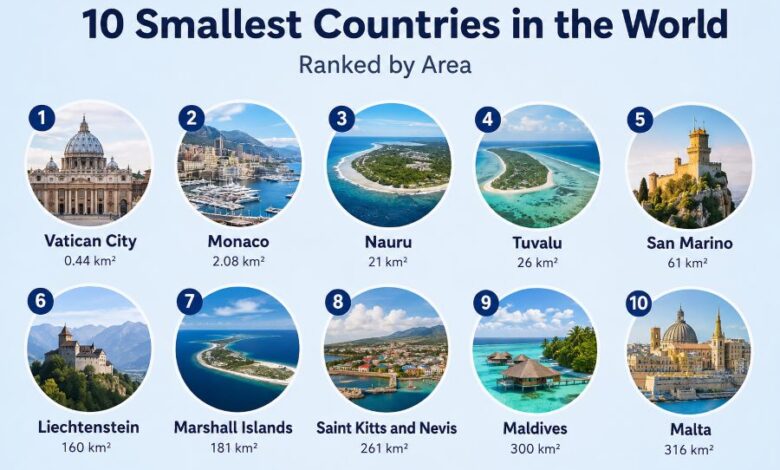
From Vatican City to Malta, these tiny nations prove that a country does not need a huge landmass to have its own government, economy, culture, and global identity.

Introduction
Some countries stretch across millions of square kilometres.
Others barely fill a city.
That contrast is huge.
The 10 smallest countries in the world include European city-states, remote Pacific islands, Caribbean nations, and one of Asia’s best-known holiday destinations.
Vatican City sits at number one. Its whole territory covers just 0.44 square kilometres. At the other end of this top-ten list is Malta, at about 316 square kilometres.
Small does not mean simple, though.
Monaco packs tens of thousands of residents into roughly two square kilometres. Tuvalu and the Marshall Islands face serious sea-level risks. Liechtenstein has a strong industrial economy despite having less land than many large cities. Maldives spreads a tiny amount of dry land across a huge part of the Indian Ocean.
So, here is the full picture.
Quick Facts
| Rank | Country | Approx. Area | Capital | Recent Population | Currency |
|---|---|---|---|---|---|
| 1 | Vatican City | 0.44 km² | Vatican City | 882 residents at end-2024 | Euro |
| 2 | Monaco | 2.08 km² | Monaco | 38,423 in 2024 | Euro |
| 3 | Nauru | 21 km² | No official capital; government offices in Yaren | About 12,000 in 2025 | Australian dollar |
| 4 | Tuvalu | 26 km² | Funafuti | About 10,000 in 2025 | Australian dollar |
| 5 | San Marino | 61 km² | San Marino | About 34,000 in 2025 | Euro |
| 6 | Liechtenstein | 160 km² | Vaduz | About 40,000 in 2025 | Swiss franc |
| 7 | Marshall Islands | 181 km² | Majuro | About 36,000 in 2025 | US dollar |
| 8 | Saint Kitts and Nevis | 261 km² | Basseterre | About 47,000 in 2025 | East Caribbean dollar |
| 9 | Maldives | About 300 km² | Malé | About 530,000 in 2025 | Maldivian rufiyaa |
| 10 | Malta | 316 km² | Valletta | 588,254 at end-2025 | Euro |
Ranking method: sovereign states ranked by total land/surface area using current official and UN-linked figures. Dependent territories are excluded.
Area figures may differ slightly between databases because some sources round numbers differently. Monaco’s coastline has also changed through land reclamation.
1. Vatican City — 0.44 km²
Vatican City is tiny.
Really tiny.
At only 0.44 square kilometres, or 44 hectares, it is the smallest sovereign state in the world.
The country sits completely inside Rome, Italy. That makes it an enclave: one sovereign territory surrounded entirely by another country.
Vatican City came into existence as a sovereign state through the Lateran Treaty of 1929, signed between Italy and the Holy See.
There is an important distinction here.
Vatican City is the territorial state. The Holy See is the governing body of the Catholic Church and handles most diplomatic relations.
Official Vatican figures counted 882 residents at the end of 2024. Only part of that population held Vatican citizenship.
Citizenship works differently here too.
It is normally linked to a person’s job or official service rather than simply being granted because someone was born inside the country.
The territory contains some world-famous sites, including:
- St Peter’s Basilica
- St Peter’s Square
- The Vatican Museums
- The Sistine Chapel
- Vatican government buildings and gardens
Vatican City uses the euro, even though it is not part of the European Union.
A formal monetary arrangement lets it issue limited quantities of its own euro coins.
Why Vatican City stands out
It holds several unusual records.
It is the world’s smallest sovereign country by area and resident population. It is also one of the rare states that exists mainly to protect the independence of a religious governing institution.
Few countries work anything like it.
2. Monaco — 2.08 km²
Monaco is the second-smallest country in the world.
Its official area is around 2.08 square kilometres.
Yet more than 38,000 people lived there in 2024.
That creates extraordinary population density.
Monaco sits beside France on the Mediterranean coast. Italy is nearby, though Monaco does not share a border with it.
The country is a constitutional monarchy headed by the Prince of Monaco.
French is the official language.
The euro is used for everyday money, even though Monaco is outside the European Union. Like Vatican City and San Marino, it has a formal monetary agreement that allows limited production of national euro coins.
Monaco’s economy is heavily tied to high-value services.
Banking matters. Property matters too. Tourism, luxury hospitality, finance, yachting, and international events bring money into an extremely small physical space.
The country is widely known for Monte Carlo and the Monaco Grand Prix.
Property is scarce.
Land itself is valuable.
That is why Monaco has expanded parts of its territory by reclaiming land from the Mediterranean Sea.
Older websites sometimes give Monaco a smaller area. That does not always mean the information was wrong when published. The country’s physical coastline has changed.
Is Monaco a city or a country?
It is both in practical terms.
Monaco is a sovereign state with its own government and international legal identity, but nearly all of its land is densely urbanised.
There is little separation between “city” and “country” in the way people might expect in a larger nation.
3. Nauru — 21 km²
Nauru comes next.
This Pacific island nation covers only 21 square kilometres.
That makes it the world’s third-smallest sovereign country and the smallest independent island republic by land area.
Its population was estimated at roughly 12,000 people in 2025.
Nauru sits in Micronesia, part of the wider Pacific region.
One detail regularly causes confusion.
Nauru has no officially designated capital city.
Government offices are mainly based in Yaren District, so Yaren is commonly shown as the country’s de facto capital.
Nauru became independent in 1968.
Its recent history is closely tied to phosphate mining.
Phosphate deposits once brought substantial income to the island. Heavy mining also damaged large parts of the interior, leaving major environmental and land-use problems.
Today, the country has limited usable land and a very small domestic market.
The Australian dollar is used as currency.
Government activity, fishing-related income, phosphate activity, and international arrangements all matter to the economy.
Nauru joined the United Nations in 1999.
What makes Nauru unusual?
You can drive around much of the island in a fairly short period.
Yet its national story is surprisingly complex.
Few places show the link between natural-resource wealth and long-term land damage as clearly as Nauru does.
4. Tuvalu — 26 km²
Tuvalu has only about 26 square kilometres of land.
The country lies in Polynesia and consists of small islands and coral atolls spread across the Pacific Ocean.
Its population was estimated at around 10,000 in 2025.
The capital is Funafuti.
Tuvalu became independent from Britain in 1978 and operates as a parliamentary democracy under a constitutional monarchy.
The country uses the Australian dollar.
Its small size creates obvious economic limits.
There is little land.
The domestic market is tiny.
Transport is expensive.
Resources are limited.
Fishing rights and international support help bring in revenue. Tuvalu has also earned money from its internet country code, .tv.
That domain became commercially valuable because “TV” is widely understood as an abbreviation for television.
Climate risk in Tuvalu
This is one of the country’s biggest long-term concerns.
Tuvalu’s islands are low-lying.
Sea-level rise, coastal flooding, saltwater intrusion, stronger wave damage, and erosion can hit homes and public infrastructure directly.
World Bank research has repeatedly placed Pacific atoll nations such as Tuvalu among countries facing serious adaptation challenges.
For Tuvalu, climate policy is tied directly to land, housing, water, and the future of communities.
5. San Marino — 61 km²
San Marino covers about 61 square kilometres.
It is completely surrounded by Italy.
The country has roughly 34,000 residents, based on recent UN estimates, and its capital is also called San Marino.
This microstate has one very old story attached to it.
San Marino traditionally dates its foundation to AD 301 and is widely described as the world’s oldest surviving republic.
Its government system is unusual too.
Two heads of state, called the Captains Regent, serve together.
Their terms last only six months.
Italian is the main language.
San Marino is not part of the European Union, but it uses the euro through a monetary agreement.
It can issue limited quantities of San Marino euro coins.
The economy includes manufacturing, tourism, services, and financial activity.
Visitor spending also matters because San Marino’s old town, mountain setting, towers, and historic buildings bring travellers across the Italian border.
Is San Marino part of Italy?
No.
This mistake is common.
Italy completely surrounds San Marino, but San Marino is an independent sovereign state with its own government, laws, institutions, and international membership.
6. Liechtenstein — 160 km²
Liechtenstein is small but economically unusual.
Its territory covers about 160 square kilometres.
The country sits between Switzerland and Austria in the Alps.
Its capital is Vaduz.
Recent population estimates put it near 40,000 people.
German is the official language.
The Swiss franc is used as currency.
Liechtenstein is a constitutional hereditary monarchy with democratic and parliamentary institutions.
One geographic fact gets plenty of attention.
Liechtenstein is doubly landlocked.
That means it is landlocked and every country surrounding it is landlocked too.
Only a very small number of sovereign states fit that description.
Liechtenstein’s economy
Its small population does not stop it from having a substantial industrial base.
Manufacturing plays a large part.
Companies based there work in fields such as machinery, specialist industrial goods, electronics, dental products, and other high-value products.
Financial services matter too.
Income per person is extremely high by international standards, though numbers for tiny economies can move sharply from one dataset to another.
Liechtenstein is not an EU member.
It maintains close economic ties with neighbouring Switzerland and participates in European economic arrangements through other agreements.
7. Marshall Islands — 181 km²
The Republic of the Marshall Islands contains only about 181 square kilometres of land.
Yet those small pieces of land are spread across a huge area of the Pacific.
The country consists of 29 coral atolls and five main islands, along with many smaller islets.
Its capital is Majuro.
Recent UN estimates place its population at around 36,000, though population counts can differ between datasets because migration has a big effect.
The Marshall Islands became independent in 1986 under a Compact of Free Association with the United States.
The country is sovereign.
The compact creates a special relationship with the US covering areas such as defence, economic support, and migration rights.
The US dollar is used as currency.
Fishing, government services, overseas support, and related activities bring money into the economy.
Sea-level risk
The country’s geography creates serious pressure.
Most settlements are low.
Many communities sit close to the ocean.
World Bank research has warned that flooding and sea-level rise could threaten large parts of existing buildings and infrastructure in Majuro without major protection and adaptation work.
The challenge is simple to see.
There is very little higher ground.
8. Saint Kitts and Nevis — 261 km²
Saint Kitts and Nevis covers approximately 261 square kilometres.
It is the smallest sovereign country in the Western Hemisphere by area.
The federation consists mainly of two Caribbean islands:
Saint Kitts and Nevis.
Its capital, Basseterre, sits on Saint Kitts.
The population was estimated at around 47,000 in 2025.
Saint Kitts and Nevis became independent from Britain on 19 September 1983.
English is the official language.
The country uses the East Caribbean dollar.
Its political structure gives Nevis a notable degree of local authority through its own island administration.
Economy and tourism
Tourism carries a lot of weight.
Visitors come for beaches, warm weather, resorts, cruise travel, historic sites, and island scenery.
World Bank tourism data has shown that travel and tourism make up a large share of economic activity and employment.
That brings opportunity.
It also creates risk.
A sharp drop in visitors can hit jobs and business income quickly. Hurricanes can cause major damage as well.
Small island countries often feel those shocks faster than larger economies.
9. Maldives — About 300 km²
The Maldives is the smallest sovereign country in Asia by land area.
Its dry land covers only around 300 square kilometres.
Some databases use roughly 298 square kilometres, while UN-linked figures are often rounded to 300.
Either figure keeps it firmly in ninth place.
The country sits in the Indian Ocean and consists of a long chain of coral islands and atolls.
The capital is Malé.
Its population was estimated at around 530,000 in 2025.
The currency is the Maldivian rufiyaa.
Dhivehi is the national language.
A tiny land area, huge tourism name
The Maldives is far better known globally than its physical size might suggest.
Tourism is a major part of the economy.
Resort islands bring visitors from around the world, while fisheries remain another key part of economic life.
But geography creates real pressure.
Much of the country’s land sits very close to sea level.
World Bank research has reported that about 72% of Maldivian land lies less than 1.5 metres above mean sea level.
That puts coastal flooding, erosion, freshwater stress, and sea-level rise high on the national agenda.
There is another point people often miss.
The Maldives has very little land, but its islands are scattered across a broad ocean area.
So its land footprint and its maritime space tell very different stories.
10. Malta — 316 km²
Malta closes the top ten.
Its territory covers about 316 square kilometres.
The country lies in the Mediterranean Sea south of Sicily.
Its capital is Valletta.
Malta’s National Statistics Office recorded 588,254 residents at the end of 2025.
That makes Malta far more populous than most other countries on this list.
Maltese and English are official languages.
The country became independent from Britain in 1964.
Malta joined the European Union in 2004 and adopted the euro in 2008.
Unlike Vatican City, Monaco, and San Marino, Malta is a full EU member.
Malta’s economy
Services make up a large share of economic activity.
Tourism is important.
So are financial and professional services, shipping, logistics, digital businesses, and other commercial sectors.
Malta’s location between Europe and North Africa has shaped its history for centuries.
Its small territory also means land pressure is real.
Housing, roads, infrastructure, construction, and population growth all compete for limited space.
How Small Are These Countries Together?
Here is a surprising comparison.
Using the rounded area figures above, all ten countries together cover only about 1,329 square kilometres.
That sounds like a fair amount until you compare it with large cities or administrative regions.
Yet these ten territories include separate governments, legal systems, economies, borders, passports, and international relationships.
Size tells only one part.
Which Is the Smallest Country in the World?
Vatican City is the smallest country in the world.
Its territory covers just 0.44 km².
It is also the smallest sovereign state by resident population.
Monaco sits far behind it in second place at around 2.08 km².
That means Vatican City is less than one-quarter the size of Monaco.
Which Is the Smallest Island Country?
Nauru is the smallest sovereign island country by area.
Its total land area is about 21 km².
Tuvalu is slightly larger at roughly 26 km².
Vatican City and Monaco are smaller sovereign states, but neither is an island country.
Which Is the Smallest Country in Asia?
The answer is Maldives.
Its land area is around 300 km².
Its islands stretch across a much wider part of the Indian Ocean, though the combined dry land remains tiny.
Which Is the Smallest Country in Europe?
Vatican City.
It is also the smallest country anywhere in the world.
Europe has a strong presence in the top-ten list:
- Vatican City
- Monaco
- San Marino
- Liechtenstein
- Malta
That means five of the ten smallest sovereign states are European.
Which Is the Smallest Country in the Americas?
Saint Kitts and Nevis is the smallest sovereign state in the Western Hemisphere.
Its area is about 261 km².
The country lies in the Caribbean.
Smallest Country in Africa
None of Africa’s sovereign states appears in the global top ten.
The smallest country in Africa is Seychelles.
Its land area is larger than Malta, so it falls outside this list.
Smallest Country in South America
The smallest sovereign country in South America is Suriname.
It is much larger than any country in this global top-ten ranking.
Smallest Countries by Region
| Region | Smallest Sovereign Country |
|---|---|
| World | Vatican City |
| Europe | Vatican City |
| Asia | Maldives |
| Oceania | Nauru |
| North America/Caribbean | Saint Kitts and Nevis |
| Africa | Seychelles |
| South America | Suriname |
Why Do Area Numbers Differ Online?
You may see slightly different figures.
That is normal.
Maldives is often listed at 298 km² or rounded to 300 km².
Malta may appear as 315 km² or 316 km².
Monaco is another special case because land-reclamation projects have increased its territory.
Current Monaco statistical material places its area at about 2.08 km², while older pages may show roughly 2.02 km² or slightly less.
Small differences do not change the ranking.
Small Country Does Not Mean Small Population
Malta proves this clearly.
It has only 316 km² of land but recorded more than 588,000 residents at the end of 2025.
Monaco is even more extreme when density is considered.
More than 38,000 residents live inside roughly 2.08 km².
Compare that with Vatican City.
Its resident population was only 882 at the end of 2024.
Same top-ten list.
Very different population patterns.
Why Are So Many Tiny Countries Islands?
Geography explains part of it.
Small islands sometimes developed into separate political units because distance kept them apart from larger neighbours.
This pattern appears across the Pacific and Caribbean.
Nauru stands alone as a small island republic.
Tuvalu consists of distant islands and atolls.
Marshall Islands spreads tiny pieces of land across a huge ocean area.
Saint Kitts and Nevis developed as a two-island federation.
Maldives is built from coral islands and atolls.
Their political borders survived even though their land areas remained small.
Why Are Several Tiny Countries in Europe?
European history worked differently.
Places such as Monaco, San Marino, Liechtenstein, and Vatican City survived centuries of wars, treaties, changing borders, and larger neighbouring powers.
Instead of disappearing into surrounding states, they kept separate political status.
Their survival created today’s group of European microstates.
Malta followed a different path and became an independent state after British rule.
Which Small Countries Use the Euro?
Four countries in this top ten use the euro:
- Vatican City
- Monaco
- San Marino
- Malta
But there is a major difference.
Malta is an EU member.
Vatican City, Monaco, and San Marino are not.
Those three use the euro through formal monetary agreements.
Which Small Countries Use Foreign Currencies?
Several do.
Nauru uses the Australian dollar.
Tuvalu also uses the Australian dollar.
Marshall Islands uses the US dollar.
Liechtenstein uses the Swiss franc.
Using an established foreign currency can make sense for a country with a tiny population and limited domestic banking system.
Maldives uses its own currency, the Maldivian rufiyaa.
Saint Kitts and Nevis uses the East Caribbean dollar, a regional currency shared by several Eastern Caribbean economies.
Are the Smallest Countries Also the Richest?
No.
Their economic situations vary sharply.
Monaco and Liechtenstein have very high-income economies.
San Marino also reports high income per person.
Maldives depends heavily on tourism and fisheries.
Tuvalu, Nauru, and the Marshall Islands face the extra costs that come with remote locations, small domestic markets, and limited land.
So country size does not tell you whether people there are rich or poor.
The economic model matters much more.
Which Small Countries Face the Biggest Climate Risk?
Tuvalu, Marshall Islands, and Maldives stand out.
All have low-lying island communities.
Higher seas can increase coastal flooding, erosion, saltwater damage, and pressure on freshwater supplies.
The problem becomes tougher when there is little higher land available for communities to move toward.
For these states, climate planning affects roads, homes, ports, water systems, public buildings, and future settlement choices.
It is a daily national issue.
10 Smallest Countries at a Glance
Vatican City
0.44 km²
Smallest country in the world.
Monaco
2.08 km²
Second-smallest and extremely densely populated.
Nauru
21 km²
Smallest sovereign island republic.
Tuvalu
26 km²
Tiny Pacific state facing major sea-level pressure.
San Marino
61 km²
Historic republic surrounded by Italy.
Liechtenstein
160 km²
Alpine microstate between Switzerland and Austria.
Marshall Islands
181 km²
Dozens of atolls spread across the Pacific.
Saint Kitts and Nevis
261 km²
Smallest sovereign country in the Western Hemisphere.
Maldives
About 300 km²
Smallest sovereign country in Asia.
Malta
316 km²
Tenth-smallest country and the most populous state in this top-ten list based on current figures.
Final Thought
Tiny countries can carry big stories.
Vatican City fits inside Rome. Monaco has built outward into the sea. Nauru’s history was shaped by phosphate. Tuvalu and the Marshall Islands face the ocean at their doorstep. San Marino has kept its independence for centuries. Liechtenstein built a wealthy economy inside 160 square kilometres.
Then there is Maldives.
Very little land. Huge global tourism recognition.
Malta is different again. It packs more than half a million residents into the tenth-smallest sovereign territory on Earth.
That is what makes this ranking interesting.
These countries are small on a map.
Their politics, history, economies, and problems are anything but small.
Frequently Asked Questions
What are the 10 smallest countries in the world?
They are Vatican City, Monaco, Nauru, Tuvalu, San Marino, Liechtenstein, Marshall Islands, Saint Kitts and Nevis, Maldives, and Malta.
What is the smallest country in the world?
Vatican City is the smallest sovereign country. It covers about 0.44 km².
What is the second-smallest country?
Monaco is second at approximately 2.08 km².
What is the smallest island country?
Nauru is the smallest sovereign island country at about 21 km².
What is the smallest country in Asia?
Maldives is Asia’s smallest sovereign country by land area.
What is the smallest country in the Caribbean?
Saint Kitts and Nevis is the smallest sovereign country in the Caribbean and Western Hemisphere.
Is Monaco smaller than Vatican City?
No. Vatican City is much smaller. Monaco covers about 2.08 km², compared with Vatican City’s 0.44 km².
Is Malta one of the smallest countries?
Yes. Malta ranks tenth among sovereign countries by area at about 316 km².
Does Nauru have a capital?
Nauru has no officially designated capital. Most government offices are in Yaren District.
Are Vatican City and the Holy See the same thing?
No. Vatican City is the sovereign territory. The Holy See is the central governing authority of the Catholic Church and handles most international diplomatic relations.